


In this guide16 sections
- Key Points
- Do Waist Trainers Work? What the Evidence Shows
- What Does a Waist Trainer Do?
- Does a Waist Trainer Help With Belly Fat?
- Waist Trainer Before and After: Why the Photos Mislead
- Are Waist Trainers Bad for You? Waist Trainer Side Effects
- Waist Trainer Benefits: Posture, Support and Confidence
- How Long Should You Wear a Waist Trainer?
- Waist Trainers After Pregnancy and a C-Section
- Waist Trainers for Men
- Is There a Best Waist Trainer?
- Waist Trainer vs Compression Garment After Liposuction or a Tummy Tuck
- What Actually Makes a Waist Smaller?
- Frequently Asked Questions
- Getting a Smaller Waist in London
- References
Key Points
- Do waist trainers work? Only while you are wearing one. A waist trainer squeezes fat, muscle and organs inwards to give a temporary hourglass shape. It does not burn fat or permanently reshape your waist.
- The evidence is thin. In the only randomised trial of corsets for weight, just 20% of people were still wearing theirs at three months, and there was no meaningful difference in weight at two years.
- A waist trainer will not shift belly fat. Sweating under the garment loses water, not fat, and fat cannot be spot-reduced from one area.
- Waist trainer side effects include reflux, breathlessness, chafing, numbness in the outer thigh and, with long-term reliance, weaker core muscles.
- A waist trainer is not a medical compression garment and should never replace the garment your surgeon prescribes after liposuction or a tummy tuck.
- What permanently narrows a waist depends on the cause: fat responds to liposuction, loose skin and separated muscles to a tummy tuck, and flared lower ribs to rib remodelling.
Waist trainers are among the most searched-for shapewear products in the UK, and the question behind most of those searches is simple: do waist trainers work? Worn under clothing, a waist trainer or waist corset trainer pulls the midsection in and gives an instant hourglass silhouette, which is why waist trainers for women, and increasingly men’s waist trainers, are promoted so heavily on social media. What a waist trainer cannot do is burn fat, move your ribs or change your shape once the hooks are undone.
This guide sets out what the evidence says about waist training, what a waist trainer actually does to your body, the side effects, how long people wear them, and what makes a waist permanently smaller. If your goal is a slimmer or more defined middle, our guides to how to get a smaller waist and the hourglass figure explain which parts of body shape can change, and liposuction is the treatment most people with a stubborn waistline are really looking for.
Do Waist Trainers Work? What the Evidence Shows
Does a waist trainer work? The short answer is that it works for as long as it is fastened. Pull one tight and your waist measurement drops by a few centimetres straight away, because soft tissue is being pushed inwards. Take it off and the tissue springs back, usually within minutes to a few hours. That is the whole effect.
What is striking is how little research exists on something so popular. The closest thing to a proper test is a Swedish randomised trial from 2010. Adults with obesity who had lost at least 8 kg on a very low calorie diet were randomly assigned to wear a corset or not for nine months, to see whether it helped them keep the weight off. Only 20% of the corset group were still wearing it after three months. At one year the corset group had lost 11.7 kg against 9.3 kg without one, and at two years 6.1 kg against 4.4 kg, differences too small to rule out chance. The researchers concluded that corset treatment could not be evaluated because so few people could tolerate it[1].
So does a waist trainer really work for weight loss? The best evidence available does not show that waist training helps you lose weight or keep it off, and it suggests most people cannot keep wearing a waist trainer long enough to find out.
Does waist training work permanently?
No. The idea behind “training” the waist is that repeated compression gradually moulds it into a new shape. Fat and skin do not work that way: they are compressed while squeezed and return to their resting position when released. Historical accounts of Victorian tight lacing describe deformed lower ribs in women who had been corseted tightly from childhood, but that came at a cost to breathing and digestion, and nothing comparable has been shown with a modern waist trainer worn by adults. Your waist width is set by your ribs, your muscles, the fat inside and outside your abdomen, and your skin, and compression changes none of them for good. The waist-to-hip ratio calculator shows how those proportions define body shape.
What Does a Waist Trainer Do?
A waist trainer is a firm compression garment, usually made of latex or thick elastic with flexible plastic or steel strips (boning) running vertically, and fastened at the front with rows of hooks. When you do it up, it pushes the fat under the skin, the abdominal wall and the organs inside your abdomen inwards and upwards. So what can a waist trainer do? While it is on, three things happen: your waist measures smaller, the boning holds your back straighter, and the pressure on your stomach can make you feel full sooner.
None of those effects outlasts the garment. The fat you started with is still there when the hooks come undone, it has simply been pushed somewhere else for a few hours.

Waist trainer vs corset vs waist cincher
The names are used loosely, but they describe three levels of compression that all work the same way:
- Waist cincher: a shorter, lighter band around the natural waist, mainly used to smooth the line under clothes.
- Waist trainer (waist corset trainer): a longer latex or elastic garment with boning and hook closures, marketed for daily “training”.
- Corset: a rigid, steel-boned waist training corset laced at the back. Corset training, or tight lacing, means tightening it progressively over months, and it is the most compressive of the three.
The difference between a waist trainer and a corset is one of degree rather than kind. None of them removes fat or changes what lies beneath it.
Does a Waist Trainer Help With Belly Fat?
No. The idea of a waist trainer for belly fat usually rests on sweating: latex traps heat, you sweat around the middle, and the scales dip slightly. That is water, and it returns as soon as you drink.
Nor can fat be removed from one chosen area. In a 2011 randomised trial, 24 adults did seven abdominal exercises five days a week for six weeks while keeping their diet the same. Their abdominal endurance improved, but there was no change in abdominal fat, waist circumference or skinfold thickness compared with people who did nothing[2]. If working the muscles directly underneath the fat does not burn it, squeezing the fat from the outside will not either.
That also answers a question many people ask: will walking with a waist trainer help you lose belly fat? The walking burns calories; the waist trainer adds nothing except possibly making you breathless. The one plausible way a waist trainer could affect weight is by pressing on the stomach so that you eat less while wearing it, which is the same as eating less without one, and it is also the pressure that causes reflux.
Belly fat also comes in two kinds. The fat you can pinch sits under the skin, while visceral fat lies deeper around the organs, and it is visceral fat that carries the health risk. Compression reaches neither in any lasting way. If you want to compare non-surgical fat reduction honestly, our evidence reviews of fat freezing and non-surgical liposuction set out what each can and cannot do.
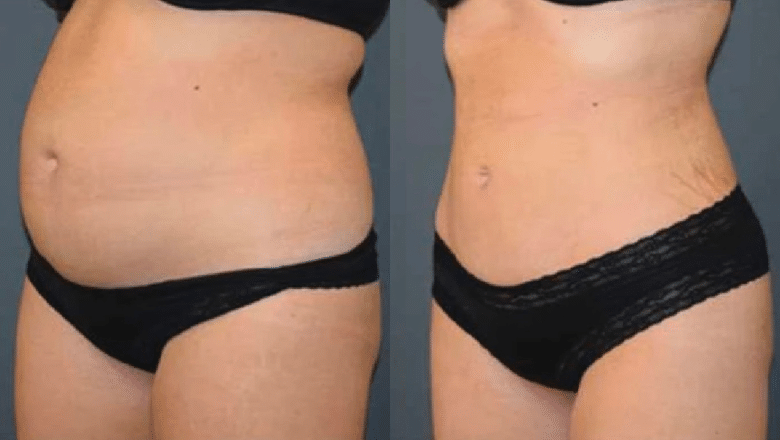
Waist Trainer Before and After: Why the Photos Mislead
Waist trainer before and after photos are the main way these products are sold, and they are rarely what they seem. The common problems are:
- The “after” photo is taken minutes after the trainer comes off, while the tissue is still compressed.
- Posture, lighting, camera angle and breathing in do much of the work.
- Waist measurements are taken with the garment on.
- Weight lost through dieting at the same time is credited to the waist trainer.
A fair test of corset waist trainer before and after results is a measurement taken at the same time of day, after a full day without the garment. On that test, waist training before and after photos show the effect of whatever diet and exercise went alongside it. Compare them with genuine liposuction before and after photos, where the change is still there months later without any garment.
Are Waist Trainers Bad for You? Waist Trainer Side Effects
Worn occasionally and not too tightly, a waist trainer is unlikely to do lasting harm to a healthy adult. Worn tightly, for long hours or in the wrong situations, it causes problems that are well explained by what compression does to the body.
Reflux and indigestion
Squeezing the abdomen raises the pressure on the stomach. In a 2014 study of healthy volunteers published in the journal Gut, simply wearing a tight waist belt pulled the junction between the stomach and gullet upwards into a small hiatus hernia and increased acid exposure just above it[3]. A waist trainer compresses far more of the abdomen than a belt, so heartburn after meals is one of the commonest complaints.
Breathlessness
The lower ribs and the diaphragm need to move for you to breathe deeply. A tight waist trainer restricts both, which is why people feel short of breath climbing stairs or exercising in one.
Weaker core muscles
When a garment holds you upright, your abdominal and back muscles do less of the work. Over months of daily use, relying on the trainer for support can leave the core weaker, which is the opposite of what most people want.
Skin problems and numbness
Trapped sweat causes chafing, rashes and fungal infections in skin folds, and some people react to latex. Tight garments that press on the front of the hip bone can also compress a nerve supplying the outer thigh, causing burning, tingling or numbness there, a condition called meralgia paraesthetica.
Circulation problems
Serious complications are rare, but they happen. Doctors in New York reported a woman who developed blocked arteries in her leg a few days after liposuction while wearing a waist training corset; after investigating every other cause, they concluded the corset had very likely triggered it[4]. That is one reason a waist trainer should never be used in place of a surgical compression garment.
Is waist training safe?
The honest answer is that it depends on how it is done. Wearing a waist trainer for a few hours under an outfit is very different from wearing one tightly all day, overnight, during exercise, during pregnancy or instead of a prescribed garment after surgery. Take it off straight away if you feel numbness, tingling, pain, dizziness, heartburn or breathlessness, and do not wear one if you are pregnant.
Waist Trainer Benefits: Posture, Support and Confidence
There are real, if modest, waist trainer benefits, and it is fair to name them. A waist trainer gives an instant smoother, narrower line under a dress, and many people find that a boost for a particular event. The boning can act as a reminder to sit up straight, although it does not correct posture: once the garment is off, posture depends on the strength of your core and back muscles. There is no evidence that waist trainers “detox” the body, speed up metabolism or benefit the organs.
Should you wear a waist trainer for the gym?
No. Exercise needs deep breathing and a core that can brace, and wearing a waist trainer while working out restricts both. The extra sweat is water, not fat. A weightlifting belt is a different thing altogether: it is worn briefly for heavy lifts to help you brace, not strapped on for a whole session to shape the waist.
How Long Should You Wear a Waist Trainer?
There is no evidence-based answer, because there is no evidence that any amount of daily wear produces a lasting result. Manufacturers often recommend building up to eight hours or more a day, but longer wear simply means more time for side effects. If you choose to wear one, keep it to a few hours for a specific occasion, loosen or remove it after meals, and do not wear it for exercise.
How long do you have to wear a waist trainer to see results? Waist training results last exactly as long as you are wearing it. What happens if you wear a waist trainer every day? The shape does not change, but the chances of reflux, skin problems and a weaker core rise with every hour.
Can you sleep in a waist trainer?
It is best not to. Lying down makes reflux worse, the garment restricts breathing while you sleep, and you are less likely to notice numbness or discomfort building up.
Waist Trainers After Pregnancy and a C-Section
A postpartum waist trainer is often marketed to new mothers as a way to “snap back”, and whether you can wear a waist trainer after a C-section is one of the commonest questions after birth. It is worth separating two very different garments. After a caesarean, some hospitals offer a soft abdominal binder to support the wound. A meta-analysis of 13 randomised trials found that binders reduced pain for the first 48 hours after a caesarean and helped women get up and walk sooner, with no increase in complications[5]. Their purpose is comfort and support, not reshaping.
A boned waist trainer pulled tight over a healing wound is not the same thing. Wait until your wound has healed and you have had your postnatal check, and ask your midwife or GP before wearing any compression garment in the weeks after birth.
The shape of the tummy after pregnancy usually has two causes that compression cannot fix: stretched skin and separated abdominal muscles, known as diastasis recti. Targeted exercise with a physiotherapist helps many women. When the gap and loose skin after pregnancy persist once you have finished having children, a tummy tuck with muscle repair is the treatment that closes the gap. Our guide to the mum tum covers the whole picture, and the mummy makeover combines tummy and breast surgery for women who want both.
Waist Trainers for Men
A waist trainer for men, whether it is sold as a male waist trainer, a sweat belt or a slimming vest, works in exactly the same way as one for women: it compresses, and the effect ends when it comes off. They tend to disappoint men even more, because men store a larger share of their belly fat as visceral fat deep inside the abdomen, where outside pressure has no lasting effect. Fat on the flanks and a softer middle are covered in our guides to the dad bod and the V-taper body, which explain what training, weight loss and liposuction can each change.
Is There a Best Waist Trainer?
No waist trainer produces a lasting change, so the best waist trainer is simply the one that does the least harm. If you choose to wear one:
- Buy your true size rather than a smaller one to “train” into.
- Make sure you can breathe deeply and slide two fingers under the edge.
- Avoid latex if you have a latex allergy or sensitive skin.
- Do not sleep, exercise or eat a large meal in it.
- Take it off at the first sign of numbness, pain, heartburn or breathlessness.
Waist Trainer vs Compression Garment After Liposuction or a Tummy Tuck
After liposuction or a tummy tuck, your surgeon will ask you to wear a medical compression garment for several weeks. It is designed to spread even pressure across the treated area, control swelling and support the skin while it settles onto the new contour. A waist trainer is designed to do something quite different: concentrate pressure at the waist to change its shape. That can create ridges and uneven pressure over healing tissue, and pressure around the groin and hips can affect circulation, as the case described above showed[4].
Wear the garment you are prescribed, for as long as you are told. Do not wear a waist trainer after lipo or after a tummy tuck, either instead of your prescribed garment or on top of it, unless your surgeon agrees. At Centre for Surgery, compression garments are purchased separately and confirmed with you in advance. Our guides to liposuction recovery and tummy tuck recovery explain how long garments are worn and why.
What Actually Makes a Waist Smaller?
A permanently smaller waist comes from changing whatever is making it wide in the first place, and that differs from person to person. A consultation with a plastic surgeon starts by working out which of the four causes below is responsible, because more than one often is.

Fat on the waist, flanks and back: liposuction
When the width is fat under the skin, liposuction removes fat cells permanently. For the waist, 360 liposuction treats the abdomen, flanks and lower back together, which is what creates a visible inward curve rather than a flatter front alone. Fat cells removed by liposuction do not grow back, although the remaining fat can still enlarge if you gain weight. If you are weighing up the options, our comparison of liposuction vs tummy tuck explains which suits which body.
Loose skin and separated muscles: tummy tuck
When the width comes from stretched skin and separated abdominal muscles, usually after pregnancy or weight loss, a tummy tuck removes the excess skin and stitches the muscles back together. That repair works like a permanent internal corset, which is what a waist trainer promises but cannot deliver. For patients who want the waist emphasised as well as the tummy flattened, the hourglass tummy tuck combines the two.

Flared lower ribs: rib remodelling
For a small number of people, the width at the waist is set by lower ribs that flare outwards. Rib remodelling reshapes those ribs inwards; nothing is removed. After the ribs are repositioned they are either held with titanium plates or supported by a fitted corset worn for around three months while the bone heals. It is the one situation where a corset genuinely helps reshape the waist, because it is holding surgically repositioned bone rather than squeezing soft tissue. It is a significant operation, planned with a CT scan, and suitable for a small minority rather than a first step.
After major weight loss: corset trunkplasty
After massive weight loss, excess skin often runs both around and down the trunk. A corset trunkplasty combines a vertical incision down the front with incisions high on the sides to tighten the trunk in both directions and create an hourglass shape; surgeons continue to refine the technique to improve how the scars and waistline settle[6]. Our guide to corset trunkplasty explains who it suits, and excess skin removal surgery covers the wider options.
At Centre for Surgery, body contouring is performed by GMC-registered plastic surgeons at our CQC-regulated Baker Street hospital, under TIVA or local anaesthetic with sedation depending on the procedure (see our guide to anaesthesia options). The surgeon who assesses you at consultation is the surgeon who performs your surgery.
Frequently Asked Questions
Do waist trainers flatten your stomach?
Only while you are wearing one. The garment pushes the stomach inwards, and it returns to its usual shape within hours of taking it off. A waist trainer does not remove fat, tighten loose skin or close separated muscles.
Does a waist trainer shape you permanently?
No. There is no evidence that a waist trainer permanently changes the shape of the waist in adults. Fat and skin return to their resting position when the compression stops.
How long do you have to wear a waist trainer to see results?
The effect appears as soon as you fasten it and disappears soon after you take it off. Wearing it for more hours or more months does not make the result last, but it does increase the risk of side effects.
Will walking with a waist trainer help lose belly fat?
The walking helps; the waist trainer does not. Sweating under the garment loses water rather than fat, and fat cannot be targeted from one area of the body.
What happens if you wear a waist trainer every day?
Your waist does not change shape, but daily wear raises the chance of reflux, chafing, skin infections, numbness in the thigh and weaker core muscles from relying on the garment for support.
Can a waist trainer damage your organs?
A waist trainer pushes the stomach, bowel and other organs inwards and upwards while it is on, which is why it can cause reflux and breathlessness. There is no good evidence of permanent organ damage from ordinary use in adults, but tight, prolonged compression is best avoided.
Do waist trainers work for men?
They work in the same limited way: a temporarily narrower waist while worn. Men carry more of their belly fat deep inside the abdomen, where compression has no lasting effect.
How do I flatten my lower belly pooch?
It depends on what the pooch is made of. Fat responds to weight loss and, where it is resistant, liposuction; loose skin and separated muscles after pregnancy respond to a tummy tuck. A consultation can tell you which you have.
Getting a Smaller Waist in London
If a waist trainer has not given you the shape you want, a consultation with a plastic surgeon will establish whether fat, skin, muscle or your ribs are responsible, and what would change it for good. Find out more about body contouring at Centre for Surgery.
Phone: 020 7993 4849 | Address: 95–97 Baker Street, Marylebone, London W1U 6RN
Contact us to schedule a consultation
References
- Wikstrand I, Torgerson J, Boström KB. Very low calorie diet (VLCD) followed by a randomized trial of corset treatment for obesity in primary care. Scandinavian Journal of Primary Health Care 2010;28(2):89–94. doi:10.3109/02813431003778540
- Vispute SS, Smith JD, LeCheminant JD, Hurley KS. The effect of abdominal exercise on abdominal fat. Journal of Strength and Conditioning Research 2011;25(9):2559–2564. doi:10.1519/JSC.0b013e3181fb4a46
- Lee YY, Wirz AA, Whiting JGH, et al. Waist belt and central obesity cause partial hiatus hernia and short-segment acid reflux in asymptomatic volunteers. Gut 2014;63(7):1053–1060. doi:10.1136/gutjnl-2013-305803
- Ramcharan MM, Hanandeh A, Donaldson B, Safavi A. Waist training corset: an unusual cause of acute lower limb ischemia. Cureus 2020;12(9):e10465. doi:10.7759/cureus.10465
- Lin SL, Yen CF, Hsieh CJ, Chang WP, Wang CH. The efficacy of abdominal binder in women undergoing cesarean delivery: a meta-analysis of randomized controlled trials. Midwifery 2025;142:104281. doi:10.1016/j.midw.2024.104281
- Drury PK, Moradi P. The extended corset with bra strap: refinements in the corset trunkplasty technique. Aesthetic Plastic Surgery 2025;49(1):287–291. doi:10.1007/s00266-024-04406-2