

In this guide17 sections
- Key Points
- How Long Is Thigh Lift Recovery?
- Which Type of Thigh Lift Recovers Fastest?
- Thigh Lift Recovery Timeline: Week by Week
- Thigh Lift Recovery After Weight Loss and Weight-Loss Injections
- Preparing for Thigh Lift Surgery
- Sitting and Sleeping After a Thigh Lift
- Compression Garments After a Thigh Lift
- Pain, Swelling and Bruising After a Thigh Lift
- Wound Care and Thigh Lift Scars
- When Can I Go Back to Work and Exercise After a Thigh Lift?
- Driving, Travel and Blood Clots After a Thigh Lift
- What Not to Do After a Thigh Lift
- When to Contact Your Surgeon After a Thigh Lift
- Thigh Lift Recovery FAQs
- Thigh Lift in London
- References
Key Points
- How long is thigh lift recovery? Most people return to desk work in one to two weeks and to full exercise at eight to ten weeks. Swelling settles over three to six months and scars keep fading for 12 to 18 months.
- Does the type of thigh lift matter? Yes. A mini thigh lift through a groin crease incision usually recovers fastest; a full vertical or extended thigh lift takes longest.
- Is a thigh lift very painful? Most people describe tightness and soreness in the groin and inner thigh rather than severe pain, worst in the first few days and controlled with prescribed painkillers.
- How long do I wear compression? Day and night for about six weeks, taking it off only to shower.
- Can I sit after a thigh lift? Yes, for short periods with your knees together. Sitting is often uncomfortable for the first two weeks, and a cushion helps.
- What should I avoid? Wide leg movements, squatting and stretching the groin, baths and swimming until the wounds have healed, strenuous exercise for at least six weeks, and smoking for four weeks before and after surgery.
Thigh lift recovery takes about six to ten weeks for most people, with scars continuing to mature for a year or more. After a thigh lift (thighplasty), most people are back at desk work within one to two weeks, walking further each day from the start, and back to full exercise at eight to ten weeks. A mini thigh lift through a short groin incision usually recovers faster than a full vertical inner thigh lift, which removes skin down towards the knee.
A thigh lift at Centre for Surgery is a day case, usually under TIVA (total intravenous anaesthesia), although the anaesthetic for your operation is decided by your surgeon and anaesthetist; our guide to anaesthesia for cosmetic surgery explains the options. This guide covers the thighplasty recovery timeline week by week, sitting, sleeping, compression, wound care, work and exercise, and the warning signs to look out for. For advice that applies to every operation, see our recovery after cosmetic surgery hub, and to see how thighs look once healed, browse our thigh lift before and after photos.
How Long Is Thigh Lift Recovery?
Thighplasty recovery time has three milestones. Getting back to everyday life, including desk work and driving, usually takes one to two weeks. Getting back to full activity, including running, the gym and heavy lifting, usually takes eight to ten weeks, and a little longer after an extended thigh lift. The final result takes longest: swelling settles over three to six months, and the scar keeps flattening and fading for 12 to 18 months.
Thigh lift scars sit in an area that moves, stretches and sweats with every step, which is why wound healing after a thigh lift needs more care than after many other operations. Your own recovery depends on the type of thigh lift, whether it was combined with other surgery, your weight and general health, and how closely you follow your aftercare. Follow your own surgeon’s instructions where they differ from this guide.
Which Type of Thigh Lift Recovers Fastest?

A thigh lift is not one single operation. The incision depends on where the loose skin is and how far down the leg it extends:
- Mini thigh lift: a short incision hidden in the groin crease, for loose skin confined to the upper inner thigh. With less tissue disturbed, recovery is usually the quickest and most comfortable.
- Medial (inner) thigh lift: the groin incision plus, where needed, a vertical incision down the inner thigh to remove skin along its length. Recovery is longer, mainly because of the wound along the inner thigh.
- Lateral (outer) thigh lift: an incision along the hip to lift the outer thigh, often as part of a lower body lift.
- Bilateral thigh lift: a combination of the medial and lateral approaches to treat the inner and outer thighs together.
- Extended thigh lift: for significant loose skin after major weight loss, with an incision that continues around the hip. Recovery is generally the longest of the group.
The evidence supports the difference. In a study of 25 people having a horizontal groin-crease thigh lift, about a quarter had a complication, almost all minor, and the authors reported fewer problems than with the combined horizontal and vertical technique[1]. A thigh lift is often combined with liposuction of the inner thighs, which can help shape the thigh and reduce the amount of skin that needs removing; your surgeon will tell you whether you need it. Your surgeon will recommend a technique at consultation and set realistic recovery expectations for it.
Your thigh lift recovery dates
Add your operation date to see the milestones in this guide as dates, then save them to your phone's calendar.
Thigh Lift Recovery Timeline: Week by Week
Day of surgery
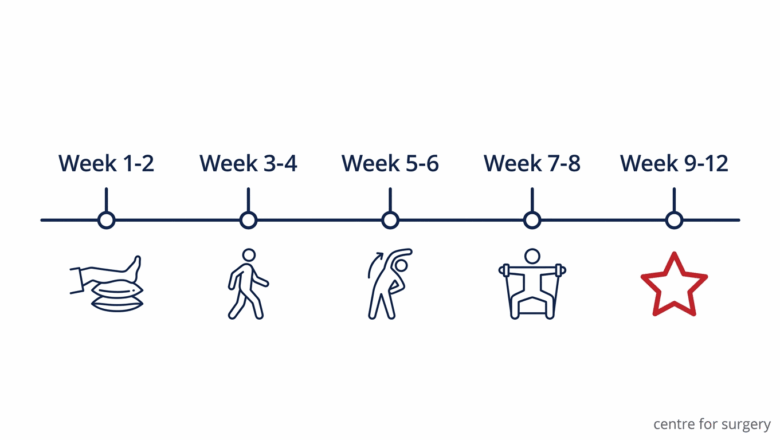
You go home the same day once you are comfortable, eating, drinking and walking. A responsible adult must take you home and stay with you for 24 hours; the Royal College of Anaesthetists’ advice for the person looking after you ↗ explains what that involves. You leave in a compression garment, and dissolvable stitches are often used to close the wounds. You are given your surgeon’s direct number for the first 24 hours on your discharge summary.
Week 1
Tightness, swelling and bruising are at their most noticeable, managed with the painkillers you are prescribed. Rest with your legs raised when lying down, but get up and walk around the house for a few minutes every hour or two while you are awake. Short, frequent walks of 10–15 minutes matter more after a thigh lift than after most operations, because they keep blood moving in your legs. Keep your knees together when you sit, stand up and get in and out of bed, and avoid wide steps. You have follow-up reviews as you heal; your discharge information gives the dates.
Week 2
Pain and swelling start to ease, although the groin and inner thigh still feel tight. The incisions may look red and tender, which is normal. Walks can get a little longer. Many people with desk jobs return to work towards the end of this week, ideally with a cushion and the chance to get up regularly.
Weeks 3–4
Swelling keeps reducing and the incisions may start to itch as they heal. Keep walking every day, but avoid anything strenuous, squatting, lunging or stretching the inner thigh. If you need to travel, take regular breaks to walk.
Weeks 5–6
Pain and swelling are much reduced. Low-impact exercise such as a static bike with low resistance or gentle swimming, once the wounds have fully healed, may be possible with your surgeon’s agreement. Around six weeks is when most people stop wearing compression day and night, once their surgeon agrees.
Weeks 7–10
Discomfort is minimal and most normal activities are back. With your surgeon’s agreement you can build up towards your usual exercise, including running and lower-body weights, usually from about eight to ten weeks. Start gently and stop if anything pulls on the scars.
3–12 months
Most swelling has settled by three months, and the final shape is clear by about six months. Scars change most slowly, fading from red or pink to pale and flattening over 12 to 18 months.

Thigh Lift Recovery After Weight Loss and Weight-Loss Injections
Most people who have a thigh lift have lost a large amount of weight, and more of them now do so with weight-loss injections. Loose inner thigh skin often causes chafing, rashes and difficulty finding clothes that fit; our guide to skin irritation after weight loss explains why. Recovery is safest when your weight has been stable for several months, you are eating enough protein and any anaemia has been treated. A review of safety in body contouring after major weight loss recommended a stable weight before surgery, ideally a BMI below 32, stopping smoking, a nutritional assessment, a check for anaemia and measures to prevent blood clots[2].
Weight matters for healing too. In a 16-year study of 151 thigh lifts in the Journal of Cutaneous and Aesthetic Surgery ↗, almost half of patients had some kind of wound-healing problem, mostly minor and managed without further surgery. The risk rose with higher BMI and age, and smoking was linked to scar problems[3]. That is why your surgeon may suggest losing a little more weight before a thigh lift, and why stopping smoking matters.
If you have lost weight with an injection, tell us at consultation and again before surgery. These medicines can slow the emptying of the stomach, so your team will tell you whether and when to pause them before your anaesthetic. In a 2025 study of 590 body contouring patients, including people having thigh lifts, those who had used GLP-1 weight-loss medicines before surgery had similar 30-day readmission and emergency visit rates to matched patients who had not[4]. Our guide to skin removal surgery after losing weight quickly covers timing in more detail, and our excess skin removal surgery page explains how procedures can be staged or combined.
Preparing for Thigh Lift Surgery
Stop smoking and all nicotine products at least four weeks before surgery and for four weeks afterwards, because nicotine reduces blood flow to healing skin; the NHS Quit Smoking service ↗ offers free support. Aspirin is usually stopped two weeks before surgery, but only on medical advice, and your surgeon will tell you about any other blood thinners or supplements. Eat well and stay active in the weeks before your operation.
At home, set up a place to rest with your legs raised, keep everyday things within easy reach, and buy loose, soft clothing that is easy to pull on over a compression garment. Arrange help with shopping, lifting and childcare for the first week or two. You will not be able to drive yourself home. Our guide to preparing for cosmetic surgery has a full checklist.
Sitting and Sleeping After a Thigh Lift
Sitting after a thigh lift
You can sit from the first day, but keep it short and keep your knees together. Sitting is often uncomfortable for the first two weeks, especially after a medial or bilateral thigh lift, because it presses on the groin wound. A firm cushion helps, and getting up to walk every 30–60 minutes eases stiffness and helps your circulation. Avoid sitting cross-legged or with your legs wide apart until your surgeon says the wounds are secure.
Sleeping after a thigh lift
Sleep on your back with a pillow or two under your knees and calves to keep your legs slightly raised, which reduces swelling. Keep your legs straight and close together rather than apart. Avoid sleeping on your front or side until your surgeon confirms it is safe, usually after two to three weeks. Our guide to how to sleep after body lift surgery has more tips on positioning and pillows.
Compression Garments After a Thigh Lift
Wear your compression garment day and night for about six weeks, taking it off only to shower. It supports the healing tissue, helps control swelling and helps the skin settle smoothly over the new contour; leaving it off early can increase swelling. Make sure it lies flat without creases, which can mark the skin, and that the edges do not dig into the groin wound. Compression garments are bought separately, and your coordinator confirms which ones you need in advance. Our guide to the benefits of wearing a compression garment explains how to get a good fit.
Pain, Swelling and Bruising After a Thigh Lift
Most people describe tightness and soreness in the groin and inner thigh rather than severe pain. It is worst in the first few days, eases steadily over the first two weeks, and is controlled with the painkillers you are prescribed. Take them regularly at first rather than waiting for pain to build.
Swelling and bruising are expected. They are most noticeable in the first week, ease by weeks three to four and are much reduced by six weeks. Some swelling around the knee, lower leg and ankle is common, because fluid drains downwards; it can take a few months to settle fully, especially after an extended thigh lift. To help it settle, raise your legs when resting, wear your compression garment, keep walking, use a cold compress wrapped in a cloth for short periods in the first 48 hours, drink plenty of water and limit salty food. If you also had liposuction elsewhere, our liposuction recovery guide explains what to expect from those areas.
Wound Care and Thigh Lift Scars
The groin is warm, moist and moves with every step, so it is the area most likely to heal slowly. Keep the wounds clean and dry, pat them dry after showering, and avoid wide leg movements that pull on the scar. Showering is usually fine from 48 hours after surgery, but avoid baths, swimming pools and hot tubs until the wounds have fully healed, usually around four to six weeks. A small area of the wound opening or a slow-healing spot near the groin is fairly common and usually heals with dressings.
Thigh lift scars lie in the groin crease after a mini thigh lift, and also run down the inner thigh towards the knee after a full vertical thigh lift. They usually look red and slightly raised for the first few months, then fade and flatten over 12 to 18 months. Once the wounds have fully closed, silicone gel or sheets can help, and protecting the scars from the sun for the first year helps them fade. Itching from about week two or three is a normal part of healing; resist scratching and use a fragrance-free moisturiser your surgeon is happy with. Our guide to thigh lift scars and how to reduce scarring covers scar care in more detail, and our guide to dog ears after surgery explains the small puckers that can form at the end of a scar.
When Can I Go Back to Work and Exercise After a Thigh Lift?
Going back to work
Most people with desk-based jobs return to work after one to two weeks, and sometimes a little longer after a full vertical thigh lift because sitting for long periods is uncomfortable at first. Jobs that involve standing all day, walking long distances, lifting or squatting usually need four to six weeks.
Exercise after a thigh lift
- From the first day: short walks around the house every hour or two while you are awake.
- From about two weeks: gradually longer walks at an easy pace.
- From about six weeks: low-impact exercise such as a static bike with low resistance, upper-body work and gentle swimming once the wounds have fully healed, with your surgeon’s agreement.
- From about eight to ten weeks: running, lunges, squats and lower-body weights, built up gradually.
Our guide to exercising after cosmetic surgery explains how to build back up safely.
Driving, Travel and Blood Clots After a Thigh Lift
Do not drive for at least 24 hours after an anaesthetic or sedation. Most people drive again after one to two weeks, once they are off painkillers that cause drowsiness and can do an emergency stop without pain. Check your insurance policy, as some insurers require a longer gap.
Leg surgery, reduced movement and long journeys all raise the risk of a blood clot in the leg (deep vein thrombosis, or DVT), as the NHS guidance on DVT ↗ explains. The risk does not end after the first few days: in a study of 1,126 plastic surgery patients who did not receive blood-thinning injections, more than half of the clots in those at highest risk were diagnosed between two weeks and two months after surgery[5]. Keep walking regularly throughout your recovery, drink plenty of water, avoid long journeys for the first few weeks, and take any blood-thinning injections exactly as prescribed.
What Not to Do After a Thigh Lift
- Stretch the groin. No wide steps, squatting, lunging or sitting with your legs apart for the first few weeks.
- Sit still for long periods. Get up and walk every 30–60 minutes while you are awake.
- Soak the wounds. No baths, swimming or hot tubs until the wounds have fully healed.
- Take your compression garment off early, including at night, unless your surgeon advises it.
- Lift heavy objects or do strenuous exercise for at least six weeks.
- Smoke or use nicotine for at least four weeks after surgery.
- Drink alcohol in the first week or two, or while taking strong painkillers.
- Expose the scars to the sun for the first year without clothing or a high-factor sunscreen.
Eating well helps you heal. Base your meals on protein, fruit and vegetables, drink plenty of water, and limit salty and heavily processed food, which encourages swelling.
When to Contact Your Surgeon After a Thigh Lift
Wound problems are the most common issue after a thigh lift, and most are minor. Liposuction helps: a 2025 systematic review of 19 studies and 1,113 patients in the Journal of Clinical Medicine ↗ found that inner thigh lifts with liposuction had markedly fewer complications than those without, including fewer seromas (fluid collections, about 9% compared with 25%), haematomas and infections[6].
Contact your surgical team straight away if you have:
- a temperature, or spreading redness, heat, pus or a bad smell from a wound
- a part of the wound opening up, or bleeding that soaks through your dressing
- sudden swelling or a growing, fluid-filled lump in one thigh or the groin
- pain that is getting worse rather than better
- a painful, swollen calf, or breathlessness (call 999 for chest pain or difficulty breathing)
For the first 24 hours, call your surgeon on the direct number on your discharge summary. After that, call the clinic on 020 7993 4849, 9am–6pm Monday to Saturday, and NHS 111 out of hours, or 999 in an emergency. Our guide to skin removal surgery complications explains how to lower your risk.
Thigh Lift Recovery FAQs
How far can I walk after a thigh lift?
In the first week, aim for short walks of 10–15 minutes every hour or two while you are awake, rather than one long walk. Build up gradually from the second week. Walking helps prevent blood clots and swelling, but stop if the wounds feel as if they are pulling.
When can I take a bath after a thigh lift?
Showering is usually fine from 48 hours after surgery. Baths, swimming and hot tubs should wait until the wounds have fully healed, usually around four to six weeks.
Do thigh lift stitches need removing?
Dissolvable stitches are often used, in which case there are no stitches to remove; your surgeon will tell you which you have. Either way, you have follow-up reviews as you heal, and your discharge information gives the dates.
What should I wear after a thigh lift?
Your compression garment day and night for about six weeks, with loose, soft clothing over it. Skirts, dresses and loose trousers that pull on easily are more comfortable than anything tight at the groin.
What are the scars like after thigh lift surgery?
A mini thigh lift leaves a scar in the groin crease, usually hidden by underwear. A full thigh lift adds a vertical scar down the inner thigh. Scars are red at first and fade and flatten over 12 to 18 months.
Why are my ankles swollen after a thigh lift?
Fluid drains downwards, so swelling around the knee, calf and ankle is common for several weeks. Raising your legs and walking help. Swelling that is sudden, painful or much worse in one leg should be checked straight away, because it can be a sign of a blood clot.
Can a thigh lift get rid of cellulite?
A thigh lift can improve the look of cellulite in the area of skin that is tightened or removed, but it is not a treatment for cellulite and some may remain or return over time.
Will my thighs stay smaller after a thigh lift?
The skin that was removed does not come back, but skin continues to age and some laxity can return over time, especially with large changes in weight. Keeping your weight stable is the best way to protect the result.
Can I combine a thigh lift with other procedures?
Yes. A thigh lift is often combined with liposuction, a tummy tuck, an arm lift or a lower body lift. Combining procedures means one recovery rather than several, but a longer and harder one. Our tummy tuck recovery, arm lift recovery and body lift recovery guides explain what each adds.
Where can I see thigh lift results?
Our thigh lift before and after gallery shows results from our own patients, including inner thigh lifts and thigh lifts after weight loss, photographed at least six months after surgery.
Thigh Lift in London
Thigh lift surgery at Centre for Surgery is performed by GMC-registered surgeons at our CQC-regulated Baker Street hospital, rated Good overall by the CQC. The consultant who assesses you at consultation is the consultant who performs your surgery, and you have follow-up reviews as you heal; your discharge information gives the dates. Liposuction of the inner thighs is added where it helps. Your initial consultation is £100, redeemable against the cost of surgery if you go ahead; our thigh lift cost guide explains what the price includes, and finance is available, subject to status. Read more about the operation on our thigh lift surgery page.
Phone: 020 7993 4849 | Address: 95–97 Baker Street, Marylebone, London W1U 6RN
Contact us to schedule a consultation
References
- Schwaiger K, Russe E, Heinrich K, et al. Thighplasty: improving aesthetics through revival of the medial, horizontal procedure: a safe and scar-saving option. Journal of Plastic, Reconstructive and Aesthetic Surgery 2018;71(4):585–589. doi:10.1016/j.bjps.2017.10.002
- Colwell AS, Borud LJ. Optimization of patient safety in postbariatric body contouring: a current review. Aesthetic Surgery Journal 2008;28(4):437–442. doi:10.1016/j.asj.2008.04.007
- Kühn S, Klettenheimer A, Küenzlen L, et al. Outcome, complications, and body mass index correlation of horizontal and combined horizontal and vertical thigh lift: a 16-year single-center experience. Journal of Cutaneous and Aesthetic Surgery 2019;12(4):231–236. doi:10.4103/JCAS.JCAS_115_18
- Liang J, Pillai T, Chopra S, et al. Postoperative outcomes in body contouring procedures following glucagon-like peptide-1 receptor agonist use: a 10-year analysis. Aesthetic Surgery Journal 2025;45(5):501–507. doi:10.1093/asj/sjaf029
- Pannucci CJ, Bailey SH, Dreszer G, et al. Validation of the Caprini risk assessment model in plastic and reconstructive surgery patients. Journal of the American College of Surgeons 2011;212(1):105–112. doi:10.1016/j.jamcollsurg.2010.08.018
- Albanese R, Blessent CGF, Tomaselli F, et al. A comprehensive review of medial thighplasty: the role of liposuction in reducing complications and optimizing patient outcomes. Journal of Clinical Medicine 2025;14(7):2426. doi:10.3390/jcm14072426