

In this guide16 sections
- Key Points
- What Does a Good Liposuction Result Look Like?
- Will Liposuction Give Me a Smooth, Sculpted Body Shape?
- Will Liposuction Leave Visible Scars?
- Can Liposuction Cause Lumps and Bumps?
- How Do You Make Liposuction Look Natural?
- How Long Does It Take to See Liposuction Results?
- Are Liposuction Results Permanent?
- Does Liposuction Tighten Loose Skin?
- What Are the Signs of Bad Liposuction Results?
- Who Gets Good Liposuction Results?
- How Can I Get the Best Liposuction Results?
- What Happens at a Liposuction Consultation at Centre for Surgery?
- Frequently Asked Questions
- Liposuction in London
- References
Key Points
- What does a good liposuction result look like? A smooth, sculpted contour that suits your frame, scars that are small and hard to see, no lumps or dents, and proportions that look natural rather than operated on.
- How long do liposuction results take? A first change shows at around six weeks, and the final result appears at three to six months once swelling has settled.
- Good lipo results depend on the fat that is left behind. Surgeons judge a result by what remains, not by the volume removed. Most people have one to four litres taken, and liposuction is body contouring rather than weight loss.
- Are liposuction results permanent? Fat cells that are removed do not grow back, but the cells that remain can still enlarge if you gain weight.
- Liposuction does not tighten loose skin. Firm, elastic skin usually retracts well, while looser skin may need BodyTite, Argo Plasma skin tightening or a tummy tuck.
- Swelling can make a good result look poor. Lumpiness and asymmetry are common early on, but a lump or dent that is still there after the swelling has gone deserves a review with your surgeon.
A good liposuction result is one that nobody can spot. People often assume the aim is to remove as much fat as possible, yet the surgeons at Centre for Surgery say the opposite: it is the fat left behind, and how evenly it is left, that decides whether your lipo results look natural. Done well, liposuction (also called liposculpture or lipo) restores a smooth outline that matches your build and leaves nothing to give the operation away.
This guide sets out the four features of a good liposuction result, how to tell good lipo results from poor ones, how long it takes for the final result to show, whether liposuction results last, and what to do if something does not look right. If you are still deciding whether the operation is for you, our guides on whether liposuction is worth it and whether you are suitable for liposuction are a good place to start, and our liposuction before and after photos show what real results look like.
What Does a Good Liposuction Result Look Like?
A good liposuction result has four features, and all four matter together. The contour is smooth and sculpted, the scars are barely visible, the skin is free of lumps and bumps, and the overall shape looks natural for your body. A result can fail on any one of them even when a lot of fat has been removed, which is why the volume taken is a poor measure of success.
It also helps to know what a good result is not. It is not a dramatically smaller body, a different body type or a flat stomach on someone with loose skin and separated muscles. Liposuction removes pinchable fat from specific areas. Where the problem is skin, muscle or the fat deep inside the abdomen, the honest answer may be a different operation, as we explain in our guide to liposuction vs tummy tuck.
Will Liposuction Give Me a Smooth, Sculpted Body Shape?
Yes, when the operation is planned around your proportions rather than around the amount of fat. The ideal liposuction result closely follows your existing frame, with the stubborn areas refined so the curves flow into each other. The relationship between your waist, hips and thighs is the main thing to protect, because over-treating one area can create a flat, boxy or hollowed look that is hard to correct.
During surgery your surgeon contours the treated area in layers, checking it by touch and by eye from several angles. A final pass, called fat equalisation, smooths the layer that is left under the skin. For the waist, abdomen, flanks and back together, 360 liposuction treats the whole circumference so that the new curve is continuous rather than stopping at an edge. Areas such as the stomach, love handles and back each have their own guide.
Technique matters too. At Centre for Surgery liposuction is performed with power-assisted liposuction or VASER liposuction, which are often combined, and our guide to the different types of liposuction explains how they compare. What shapes your result most is still your surgeon’s judgement about where to stop.

Will Liposuction Leave Visible Scars?
A good liposuction result leaves scars that most people never notice. Liposuction is done through 3 to 5 mm incisions, just wide enough for the thin cannula, and your surgeon places them in natural skin folds or beside existing scars, using as few as the area allows. They are closed with dissolvable stitches and typically fade to faint marks that keep maturing for up to 12 months.
Scars are larger when liposuction is combined with another operation, such as a tummy tuck, because that adds its own incision. Silicone gel from around four weeks and sun protection help the marks to fade, and if you have ever formed raised or keloid scars you should say so at your consultation. Our guide to liposuction scars covers healing in detail, and a darker mark or tender scar is something to show your nurse or surgeon rather than wait out.
Can Liposuction Cause Lumps and Bumps?
It can, and it is the most common aesthetic complaint after liposuction, so it is the feature to watch most closely. A good result is smooth to look at and to touch, with no ridges, dents or hard areas. Lumpiness in the first weeks is usually swelling, bruising and healing tissue rather than a permanent problem, and the treated area often feels firm and uneven for months before it softens.
When irregularities are permanent, the causes are usually technical: uneven removal, working too close to the skin, or very little fat left in one area. In a 50-patient series of abdominal etching, a technique that places liposuction in a superficial plane to show muscle definition, contour irregularities were the most common minor complication, affecting 12% of patients[1]. Surgeons who describe a newer approach to high-definition work say that avoiding very superficial cannula passes lowers the risk of surface irregularities[2]. That is why a conservative, layered approach, rather than an aggressive one, usually gives the smoother result.
Why do I look lumpy or bigger 3 weeks after liposuction?
The cause is almost always swelling. Bruising usually settles within two to three weeks, but deeper swelling can last three to six months, so the area can look fuller or uneven before it looks better. Keep wearing your compression garment, walk daily, and judge the result at three months rather than three weeks. Lymphatic drainage massage after liposuction may be advised after multi-area treatment.
Does liposuction cause cellulite or make it worse?
Liposuction does not treat cellulite, which sits in the skin’s fibrous bands rather than in the fat that is removed, and it can occasionally make dimpling more noticeable. Our guide to whether liposuction can remove cellulite explains the difference between cellulite, stubborn fat and skin laxity.
How Do You Make Liposuction Look Natural?
Natural-looking liposuction respects the body you have. The result should be recognisably yours, with proportions that fit your height, frame and the way you carry weight, and no obvious sign that fat has been taken from one place and not another. Three things drive this.
- Restraint. Removing too much fat can leave a hollowed or flattened look and change your proportions. We limit each session to five litres, and most people have one to four litres removed, so the fat that remains still gives your body its softness. Our guide to how much fat can be removed explains the limits.
- A stable, healthy weight. Liposuction works best when your weight has been steady for at least three months and is close to a healthy level, with pockets of fat that diet and exercise have not shifted.
- Realistic goals. It is a common misconception that liposuction is a weight-loss treatment. Most people lose only a kilogram or two on the scales, and the change shows in how clothes fit. Our guide to how much weight you can lose with liposuction goes into detail.
The limit on what liposuction can do is shown by a widely cited trial of large-volume abdominal liposuction in women with obesity. In that 2004 New England Journal of Medicine study ↗, removing a large amount of fat did not improve insulin sensitivity or other heart-disease risk factors 10 to 12 weeks later[3]. Liposuction changes shape. It does not replace weight loss for health.

How Long Does It Take to See Liposuction Results?
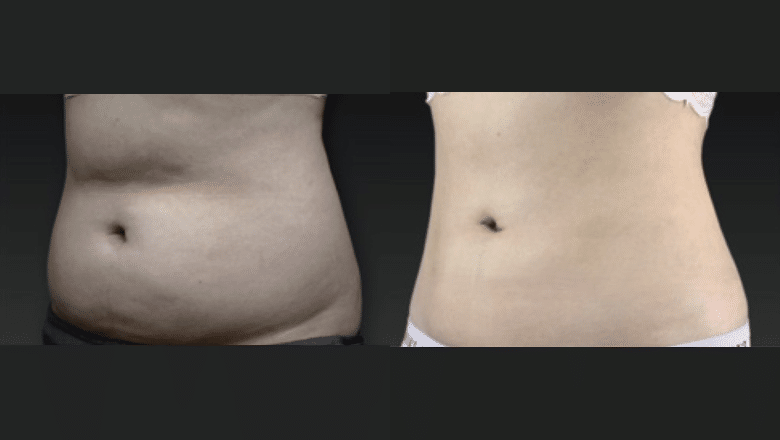
You see an early change from about six weeks and the final result at three to six months. In the first days the treated areas are swollen, sore and bruised, and you wear a compression garment continuously for six weeks. By the six-week surgeon review most of the swelling has gone, you can resume full exercise, and the outline is clearly different. The last stage, as residual swelling settles and the tissues soften, takes until three to six months. Our liposuction recovery guide gives the week-by-week detail, and the swimsuit-ready timeline answers the question many people ask before a holiday.
The pattern is backed by measurement. In a 2026 ultrasound study of 50 patients ↗ published in Cureus, the thickness of the fat layer fell most at one week, rebounded partly at one month as the tissue swelled and then stabilised by six months, at 36% to 44% below the starting thickness. The patients had large-volume liposuction, more than we perform, but the lesson holds: the early picture overstates both the improvement and the swelling. The same study found that tape-measure waist changes did not track the local fat loss well[4], so photographs taken at the same angle are a better way to judge your result than the scales or a tape.

Are Liposuction Results Permanent?
The fat cells removed do not grow back, so the change in the treated area is lasting. What liposuction cannot do is stop you gaining fat. If you put on weight, the remaining fat cells enlarge, and since the treated areas have fewer cells, the gain tends to show elsewhere.
The only randomised trial of its kind followed 32 non-obese women after small-volume liposuction. In the 2011 randomised trial in Obesity ↗, overall body fat had returned to its earlier level at one year, and the fat had come back in a different pattern: the thigh area stayed reduced, while fat reaccumulated around the abdomen[5]. The women had been asked to keep their lifestyle unchanged, and the trial was small, so it is a caution rather than a verdict. It is also why we ask for a stable weight before surgery and for steady habits afterwards.
Longer follow-up is encouraging. In a small survey of 32 patients seen on average nearly nine years after tumescent liposuction, evaluators rated skin laxity and firmness as improved, and 85.7% would recommend the operation[6]. Our guides to whether liposuction is permanent, whether fat can come back after liposuction and how to prevent weight gain after liposuction cover how to protect the result, and maintaining your liposuction results sets out the habits that help.
Does Liposuction Tighten Loose Skin?
Not on its own, and this is the most important limit on a good result. Liposuction removes fat and relies on the skin to shrink back over the new contour. Firm, elastic skin usually does so well. In a 2026 study of 59 people having abdominal liposuction with laser assistance, a technique we do not use, the upper-abdominal skin retracted by about 1.9 cm on average, with more retraction in people whose skin was more elastic before surgery[7]. Skin that has lost elasticity through age, pregnancy or major weight loss may not retract fully, and liposuction can then reveal looseness that the fat was hiding.
The fix depends on how much looseness there is. For mild to moderate laxity, BodyTite or Argo Plasma skin tightening can be combined with fat removal. For significant loose skin, with or without separated muscles, a tummy tuck is the operation that removes the skin, and our guide to loose skin vs fat helps you work out which you have. If you are worried about skin after surgery, our advice on loose skin after liposuction covers prevention and treatment.


What Are the Signs of Bad Liposuction Results?
Bad liposuction results usually show up as one of a handful of problems, and most are easier to correct if they are raised early. The signs to look for once the swelling has settled are:
- Visible dents, ridges or waves that you can see and feel after three to six months.
- Asymmetry, where one side is clearly flatter or fuller than the other.
- A hollowed or overdone look, where too much fat has been removed.
- Loose or crepey skin over the treated area that has not retracted.
- A hard, persistent lump, or a fluid collection (seroma) that keeps refilling.
- Prominent, dark or tender scars.
Most of these are not signs that something dangerous has happened. Some settle on their own, some respond to massage, and a minority need a revision operation after the tissues have healed fully, usually at least six months later. Our guide to botched liposuction and whether it can be corrected explains what revision involves, and what happens if you are not happy with your results sets out what to do next.
Is liposuction safe?
Liposuction is safe for most healthy people when a GMC-registered surgeon performs it in a regulated hospital, but no operation is risk-free. In the 2017 Aesthetic Surgery Journal cohort study ↗ of 31,010 procedures, the 11,490 liposuction-alone cases had a major complication rate of 0.7%, defined as an emergency visit, hospital admission or further surgery within 30 days. Combined procedures carried a much higher risk[8]. Read more in our guides to liposuction risks and liposuction side effects.
When should I contact my surgeon after liposuction?
Contact the clinic promptly, and do not wait for your review, if you develop a fever, spreading redness, severe or worsening pain, a hard swelling that grows quickly, or leg pain or breathlessness. Ordinary tightness, bruising and reddish fluid leaking from the incisions for the first 24 to 48 hours are expected. For any other concern, a postoperative appointment is the right way to check whether your result is on track.
Who Gets Good Liposuction Results?
People with the right starting point get the most natural outcomes. The factors that matter are a stable weight close to a healthy level, firm elastic skin, localised pockets of fat that have resisted diet and exercise, good general health, and realistic expectations. You need to stop smoking for four weeks before and after surgery, a BMI above 30 may mean liposuction is not suitable, and you must be 18 or over; read our guide to the best age for liposuction. Men get the same results from the same principles, with the focus often on the abdomen, flanks and chest, as described on our male liposuction page.
If your problem is deeper abdominal fat that makes the belly firm and protruding, liposuction will not reach it, as our guide to visceral vs subcutaneous fat explains. If the issue is mostly the shape of the abdomen after pregnancy, the mummy makeover or a tummy tuck may suit you better.
How Can I Get the Best Liposuction Results?
The steps that most improve your result are mostly about preparation and aftercare.
- Choose a surgeon carefully. Check that they are GMC-registered, ask to see their results for the area you want treated, and make sure the surgeon who assesses you is the one who operates. Our guide to how to choose a liposuction surgeon lists what to ask.
- Prepare properly. Reach a steady weight, stop smoking and follow the pre-operative advice in our guide to how to prepare for liposuction surgery.
- Wear your compression garment. It controls swelling and helps the skin settle evenly onto the new contour. You wear it continuously for six weeks, and our guide to choosing a compression garment for liposuction explains the fit.
- Move early, rest wisely. Walk from day one, avoid strenuous exercise and heavy lifting for four weeks, and return to full exercise after your six-week review.
- Be patient. Judge your result at three to six months, not at three weeks.
- Keep your weight steady. The result is only as stable as your weight.
What Happens at a Liposuction Consultation at Centre for Surgery?
Your consultation is face to face with the GMC-registered surgeon who will carry out your operation. They examine the areas you want treated, check your skin elasticity and how much pinchable fat there is, explain which technique suits you, and tell you honestly if liposuction is not the right operation. Where a result would be better with skin tightening or a tummy tuck, they say so. Costs are confirmed in writing after the consultation, and finance options are available. There is a two-week cooling-off period from consent before surgery.
Operations take place at our CQC-regulated hospital on Baker Street, usually as a day case under TIVA, and you are given your surgeon’s direct number for the first 24 hours. You can read what patients say on our patient reviews page, and our overview of body contouring shows how liposuction fits with other options.
Frequently Asked Questions
Which liposuction gives the best results?
No single type is best for everyone. Power-assisted liposuction loosens fat with a vibrating cannula, while VASER uses ultrasound and helps in dense, fibrous areas and fine sculpting. Both are available here and often combined. The result depends more on your surgeon’s judgement, your skin and how much fat is removed than on the label.
Why do I look bigger 3 weeks after liposuction?
Swelling. Bruising settles in two to three weeks, but deeper swelling can last three to six months, so the area may look fuller or uneven for a while. Keep your garment on, keep walking and judge the result at three months.
How long does liposuction take to show results?
An early change shows at around six weeks, once most swelling has gone and your garment comes off. The final result appears at three to six months as the remaining swelling settles and the tissues soften.
What happens 10 years after liposuction?
The fat cells removed stay removed, and the result largely holds if your weight is stable. Ageing, pregnancy and weight changes still alter your shape, and fat can enlarge in untreated areas if you gain weight. In one survey of patients seen about nine years later, evaluators still rated skin firmness as improved.
How many sizes do you drop after liposuction?
There is no fixed number, because liposuction changes your shape rather than your weight. One to four litres of fat is typical, so the scales move little, but clothes fit differently where you were treated. Swelling hides the change at first.
Do you weigh more after liposuction?
Sometimes, for a few weeks. Swelling and retained fluid can cancel out the weight of the fat removed, so the scales may read the same or higher at first. This settles as the swelling goes down.
How many kg can you lose with liposuction?
Usually a kilogram or two. Up to five litres of fat can be removed in one session at Centre for Surgery, typically one to four litres, which makes little difference on the scales. If you have significant weight to lose, do that first.
Can you tell if someone has had liposuction?
Not usually, when it has been done well. The signs are irregular contours, dents, a hollowed look or small scars, and a skilled surgeon aims to leave none of them. Overdone or uneven liposuction is easier to spot than a natural result.
What age is best for liposuction?
There is no single best age. You must be 18 or over, and skin elasticity tends to be better in younger people, so skin retracts more readily. Older patients can still get a good result if their skin is reasonably firm and their weight is stable.
Liposuction in London
If you would like to know what a good liposuction result could look like for your body, a consultation with one of our GMC-registered plastic surgeons will show you what is realistic. Find out more about liposuction at Centre for Surgery.
Phone: 020 7993 4849 | Address: 95–97 Baker Street, Marylebone, London W1U 6RN
Contact us to schedule a consultation
References
- Husain TM, Salgado CJ, Mundra LS, et al. Abdominal etching: surgical technique and outcomes. Plastic and Reconstructive Surgery 2019;143(4):1051–1060. doi:10.1097/PRS.0000000000005486 ↗
- Hoyos AE, Perez Pachon ME, Vranis NM. Body contouring finesse: dynamic definition liposculpture and bipolar radiofrequency microneedling. Aesthetic Surgery Journal 2025;45(12 Suppl 2):S10–S22. doi:10.1093/asj/sjae152 ↗
- Klein S, Fontana L, Young VL, et al. Absence of an effect of liposuction on insulin action and risk factors for coronary heart disease. New England Journal of Medicine 2004;350(25):2549–2557. doi:10.1056/NEJMoa033179 ↗
- Sudha S, Biswal BS, Kumar V, et al. Ultrasonographic quantification of reduction in subcutaneous fat thickness following large-volume liposuction. Cureus 2026;18(2):e103904. doi:10.7759/cureus.103904 ↗
- Hernandez TL, Kittelson JM, Law CK, et al. Fat redistribution following suction lipectomy: defense of body fat and patterns of restoration. Obesity 2011;19(7):1388–1395. doi:10.1038/oby.2011.64 ↗
- Lipp MB, Butterwick K, Angra K, Chunhara C, Goldman MP. Evaluation of long-term outcome and patient satisfaction results after tumescent liposuction. Dermatologic Surgery 2020;46(Suppl 1):S31–S37. doi:10.1097/DSS.0000000000002498 ↗
- Žgaljardić I, Orehovec SS, Bulić K, et al. Supraumbilical skin retraction after laser assisted liposuction/lipolysis. Journal of Cosmetic Dermatology 2026;25(6):e70948. doi:10.1111/jocd.70948 ↗
- Kaoutzanis C, Gupta V, Winocour J, et al. Cosmetic liposuction: preoperative risk factors, major complication rates, and safety of combined procedures. Aesthetic Surgery Journal 2017;37(6):680–694. doi:10.1093/asj/sjw243 ↗