


In this guide17 sections
- Key Points
- What Is a C Cup? C Cup Size Explained
- What Do C Cup Breasts Look Like?
- C Cup vs B Cup vs D Cup: What’s the Difference?
- Why Is a C Cup Such a Popular Breast Augmentation Size?
- What Determines Natural Breast Size?
- How to Measure Your Cup Size at Home
- How Can I Get C Cup Breasts?
- What Size Implant Do I Need for a C Cup?
- Which Breast Implants Are Best for a C Cup?
- Breast Augmentation From an A or B Cup to a C Cup
- C Cup Breast Augmentation Before and After Photos
- Risks, Recovery and Breastfeeding After C Cup Breast Augmentation
- Can You Get C Cup Breasts Naturally?
- Frequently Asked Questions About C Cup Breasts
- C Cup Breast Augmentation at Centre for Surgery
- References
Key Points
- A C cup is not a fixed size. It means the bust is roughly 3 inches (7–8cm) larger than the under-bust, so a 32C and a 38C hold very different volumes.
- C cup breast size is largely inherited. A twin study found about 56% of the variation in cup size comes from genes, with body weight, hormones, pregnancy and age accounting for most of the rest.
- A C cup is one of the most requested outcomes of breast augmentation because it adds noticeable shape without the weight that tends to cause back, neck and shoulder discomfort in much larger sizes.
- There are four routes to C cup breasts: implants, fat transfer, a breast lift (with or without implants) and, for larger breasts, a breast reduction.
- Implant size is planned in cc, not cup letters. Many women on an average band reach a C cup with an implant of roughly 300–400cc, but chest width, existing tissue and skin decide the right volume for you.
- Most women can still breastfeed after implants, although a 2023 meta-analysis found breastfeeding is somewhat less likely than in women without implants.
Breast augmentation changes the size and shape of the breasts, and C cup boobs are one of the outcomes women ask for most often. The appeal is easy to understand: a C cup is full enough to change how clothes fit and how the figure looks, but usually light enough not to cause the physical problems linked with very large breasts. What surprises many people is how much a C cup varies from one woman to the next, and why aiming for a cup letter rather than a proportion can lead to disappointment.
This guide explains what C cup breast size actually means, what C cup breasts look like on different frames, how a C cup compares with a B or D cup, what decides your natural size, and every surgical route to a C cup, from choosing an implant size to fat transfer and lifts. If you are comparing sizes more generally, our guides to ideal breast size based on height and weight and breast shapes are useful companions.
What Is a C Cup? C Cup Size Explained
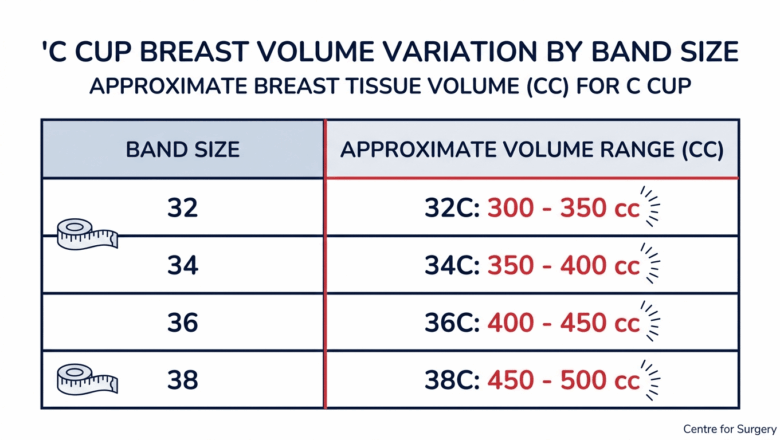
In UK bra sizing, the number is the band (the measurement around your ribcage just under the bust) and the letter is the cup. A C cup means the fullest part of the bust measures roughly 3 inches more than the band. A 34C, for example, describes a 34-inch band with breasts that project around 3 inches beyond it.
Cup size is relative, not absolute. A C cup on a 32 band is a genuinely smaller breast than a C cup on a 38 band, even though the letter is identical, and the actual volume can differ substantially. This is the single most important thing to understand before planning a C cup breast augmentation: the target is a shape and proportion on your body, not a letter on a label.
Brands also size differently, so the same woman can wear a 34C in one shop and a 32D in another. That is one reason surgeons plan with measurements and sizers rather than bra sizes.
What Do C Cup Breasts Look Like?
On most frames, C cup breasts look moderately full: they fill the cup with a visible curve, project clearly from the chest in profile and create some cleavage in a supportive bra. How they look on you depends on four things:
- Your band size and chest width. A 30C or 32C can look generous on a slim, narrow chest, while a 38C or 40C usually looks proportionate rather than large.
- Your height and build. The same breast volume looks larger on a petite woman than on a tall one.
- Breast shape. A teardrop shape with more fullness below the nipple looks different from a round shape with a full upper pole, even at the same size.
- Position. Breasts that sit higher on the chest look fuller than the same volume sitting lower, which is why a lift alone can make breasts look a cup size larger.
C Cup vs B Cup vs D Cup: What’s the Difference?
Each cup letter adds roughly one inch (about 2.5cm) to the difference between the bust and band measurements:
- A cup: about 1 inch difference
- B cup: about 2 inches difference
- C cup: about 3 inches difference
- D cup: about 4 inches difference
So, on the same band, a D cup is bigger than a C cup, and a C cup is bigger than a B cup. Across different bands the picture changes. Sister sizes hold a similar volume: a 34C holds about the same as a 32D or a 36B, because going down a band and up a cup keeps the volume roughly the same. Women who move from a B to a C cup after augmentation are often surprised that their band size changes too, especially if they were wearing the wrong size before.
Why Is a C Cup Such a Popular Breast Augmentation Size?
There is no perfect breast size, and a good result is the one that suits your frame. A C cup is popular for practical reasons as much as aesthetic ones.

Proportion and shape
Surgeons planning breast surgery look at proportions rather than cup letters. In a 2012 analysis of 100 breasts chosen as attractive, published in the Journal of Plastic, Reconstructive & Aesthetic Surgery ↗, the breasts had roughly 45% of their volume above the nipple and 55% below it, with the nipple angled slightly upwards[4]. On an average frame, a moderate increase to a C cup often achieves this kind of balance more easily than a large implant. Our guide to what perfect breasts look like covers this research in more detail.
Comfort, exercise and everyday life
Breast size affects how the body feels as well as how it looks. Women with a D cup or larger report more pain and poorer physical quality of life than women with smaller breasts, including women who have never sought surgery[5]. A C cup usually adds visible fullness without the weight that pulls on the neck, shoulders and upper back, and it is generally easier to support during running and other exercise.
Clothing and fit
Many women choose a C cup because it fills out tops, swimwear and dresses that previously gaped, while still allowing fitted, strapless and lower-cut styles to sit comfortably.
A C cup only delivers these benefits if it is proportionate to you. Choosing a size because it is the most requested, without reference to your chest width and existing tissue, can look disproportionate rather than balanced, which is why sizing is one of the most detailed parts of your consultation.
What Determines Natural Breast Size?
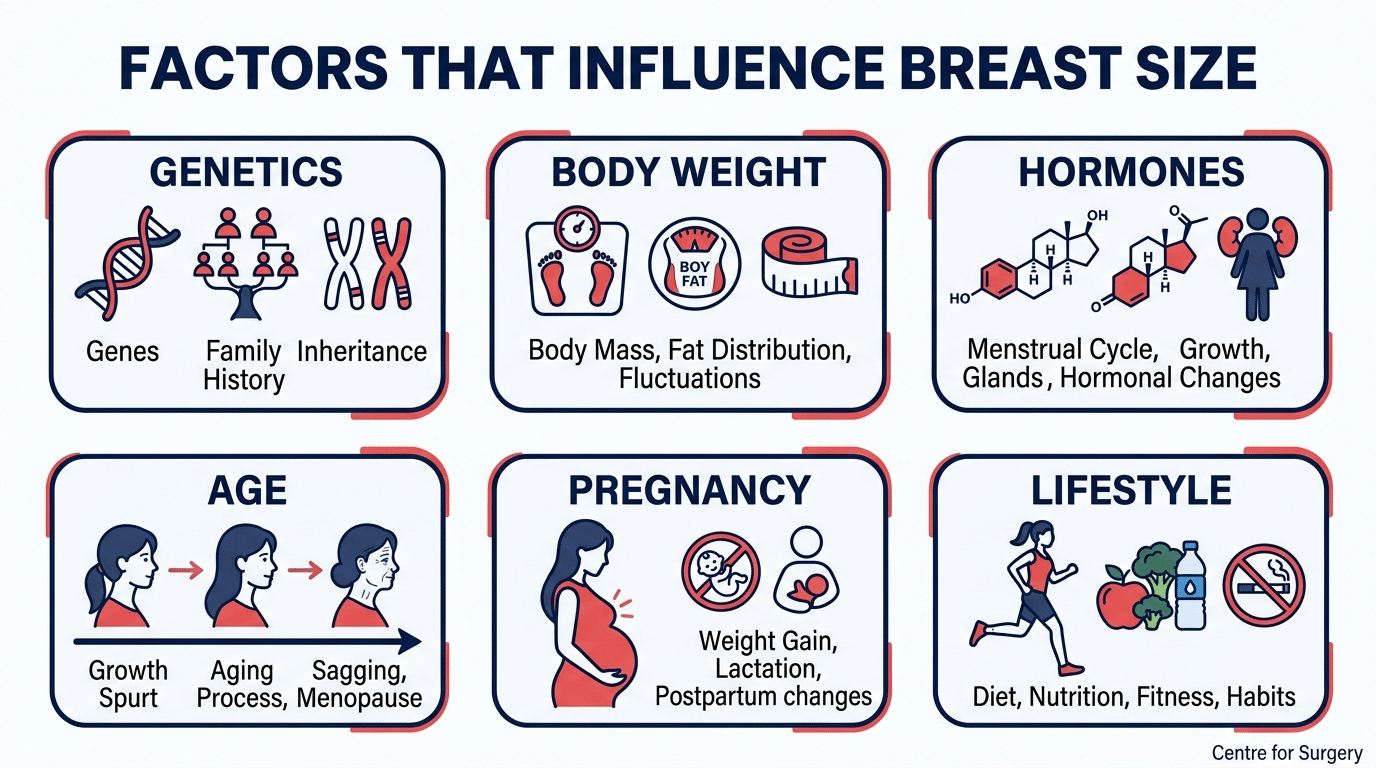
Understanding why your breasts are the size they are helps set realistic expectations for any change.
- Genetics. In a 2010 study of more than 1,000 female twins ↗, about 56% of the variation in bra cup size was explained by genes[1], and a genome-wide study of more than 16,000 women identified seven genetic variants linked to breast size[2].
- Body weight. Breasts contain a variable amount of fat, so weight change usually changes breast size. In women who lost weight after bariatric surgery, total breast volume fell as their BMI came down[3].
- Hormones. Oestrogen drives the growth of glandular breast tissue at puberty, and hormonal changes later in life affect fullness and firmness.
- Pregnancy and breastfeeding. Breasts usually enlarge during pregnancy and often lose volume once breastfeeding ends, which is a common reason women seek augmentation or a lift.
- Age. Around and after the menopause, glandular tissue is gradually replaced by fat and the breasts often become softer and lower.
- Smoking. Smoking damages skin elasticity and is linked with more sagging over time.
How to Measure Your Cup Size at Home

To estimate your cup size, measure snugly around your ribcage directly beneath your breasts for the band, then measure loosely around the fullest part of your bust while wearing a non-padded bra. Subtract the band from the bust: each inch of difference is roughly one cup size, so a 3-inch difference suggests a C cup.
Home measurements are only a starting point. In a study of 104 women, 85% were wearing an ill-fitting bra, and neither trying on several bras nor using a sizing chart reliably led them to the right one[6]. A professional fitting before consultation gives you and your surgeon a more accurate baseline.
How Can I Get C Cup Breasts?
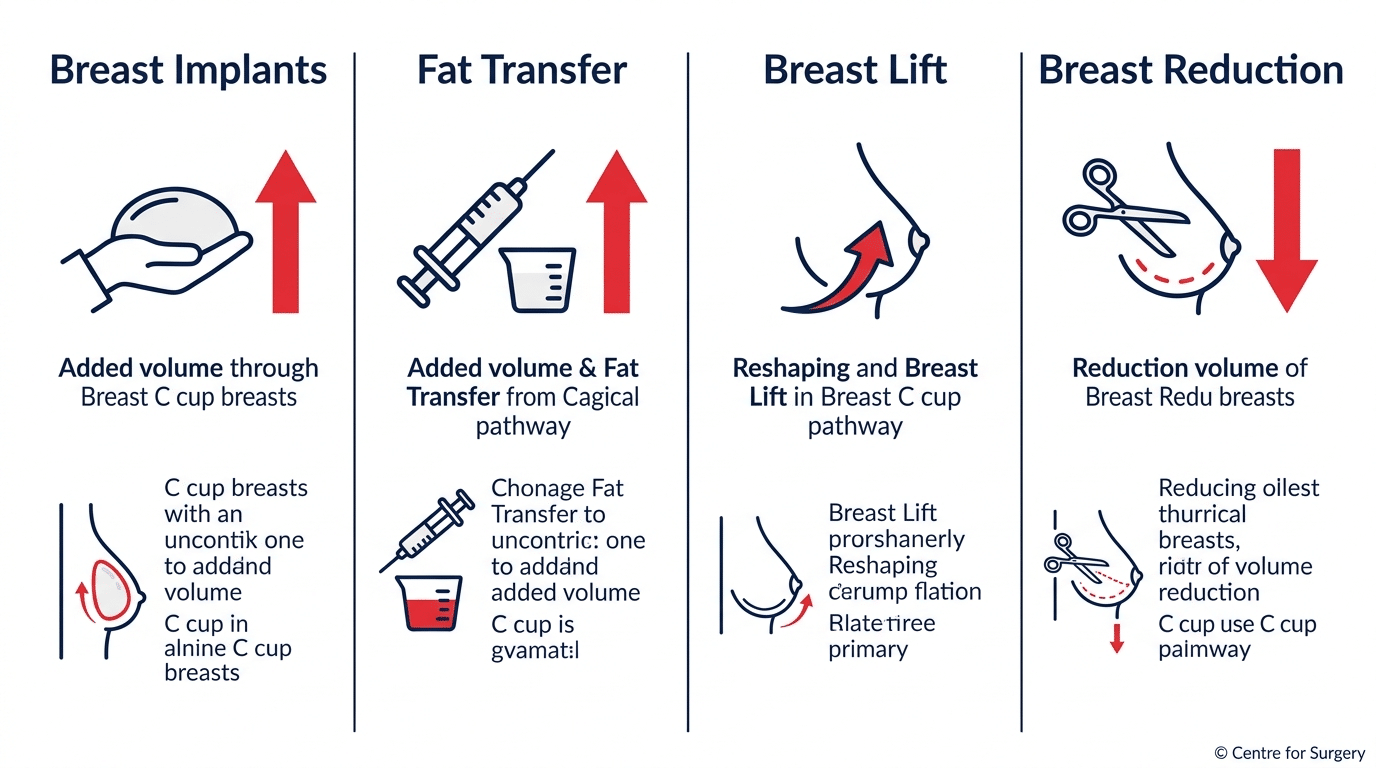
The right route depends on where you are starting from: small breasts, breasts that have lost volume, breasts that have dropped, or breasts that are larger than you would like.
Breast augmentation with implants
Breast implants are the most predictable way to reach a C cup from an A or B cup. The volume is known before surgery, and the result is visible immediately, although implants take several months to soften and settle. Where only a modest change is wanted, a mini boob job with smaller implants may be enough.
Fat transfer to the breasts
Fat transfer to the breasts uses your own fat, harvested by liposuction from areas such as the abdomen or thighs. It gives a soft, natural feel and no implant, but not all of the transferred fat survives. A 2023 systematic review in Plastic and Reconstructive Surgery ↗ of 35 studies found that on average 58% of the injected volume was retained[7], so reaching a full C cup this way often takes more than one session and suits women with enough fat to spare.

Breast lift, with or without implants
If your breasts have lost volume and dropped, often after pregnancy or weight loss, a breast lift raises the breast and nipple and reshapes the tissue. Lifting alone can make breasts look fuller, and combining a lift with an implant restores both position and volume when there is not enough tissue to fill a C cup on its own.
Breast reduction to a C cup
For women with large, heavy breasts, a breast reduction to around a C cup can relieve symptoms as well as change shape. In a 2002 prospective study, half of the women having a reduction had breast-related pain in the upper back, shoulders, neck or lower back all or most of the time beforehand, compared with fewer than one in ten afterwards[8]. Non-surgical options are compared in our guide to how to reduce breast size.
What Size Implant Do I Need for a C Cup?
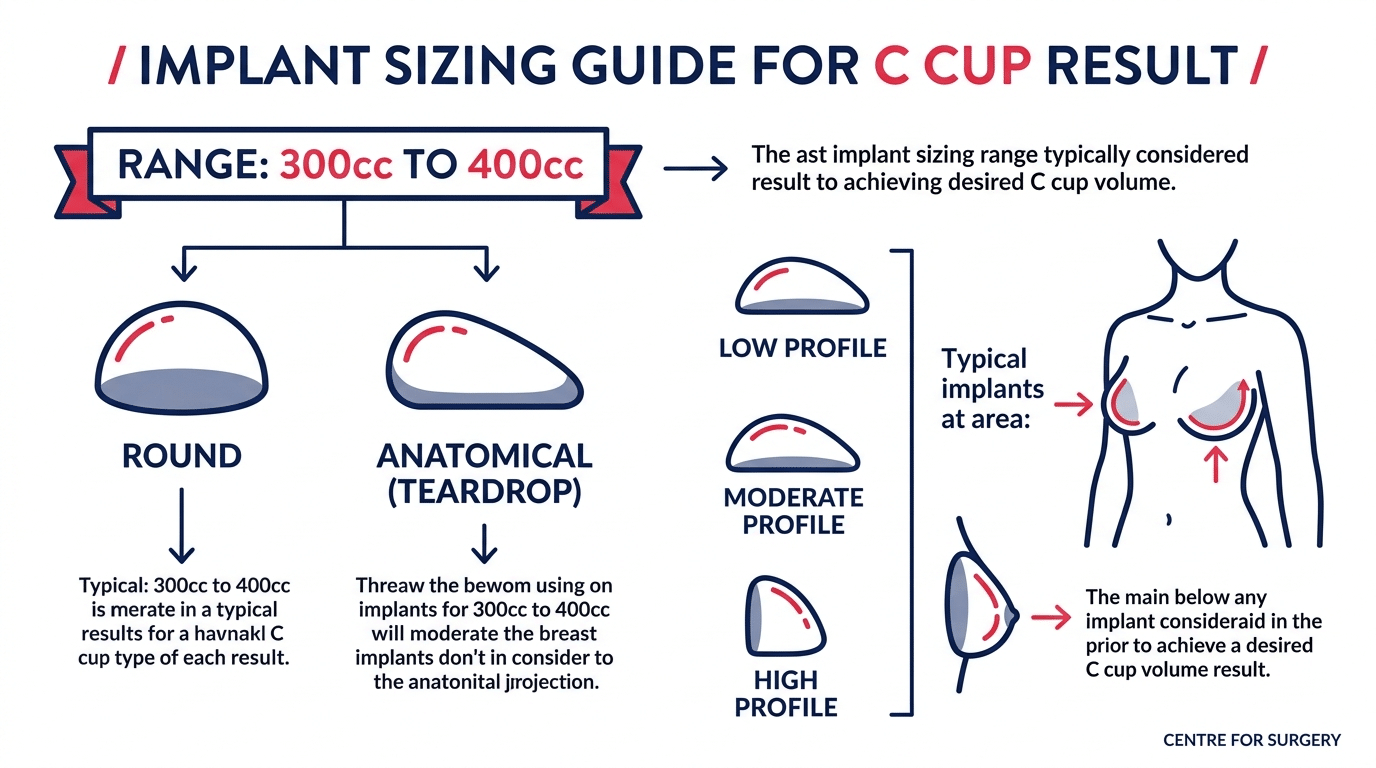
Implants are measured in cubic centimetres (cc), not cup sizes. For many women on an average band, reaching a C cup takes an implant in the region of 300cc to 400cc, but the right volume for you depends on:
- Your starting size. Going from an A cup to a C cup needs more volume than going from a small B cup.
- Your chest width and breast base. An implant should not be wider than the natural base of your breast, which limits how large it can be on a narrow chest.
- Your skin and tissue. Tight skin, common in women who have not had children, may not accommodate a large implant comfortably, while looser skin may need more volume or a lift.
- Your band size. A larger band needs more volume to reach the same cup letter.
That is why two women aiming for a C cup can need noticeably different implants. At consultation your surgeon measures your chest and breasts, and you can try sizers in a bra to see how different volumes look on your own body before deciding. Our guide to how breast implant sizes relate to bra cup sizes explains why cc and cup size never map exactly.
Which Breast Implants Are Best for a C Cup?

The right implant for a C cup is the one that fits your anatomy and the shape you want. The main choices are:
- Filling. Cosmetic breast augmentation at Centre for Surgery uses silicone gel implants, which feel closer to natural breast tissue than saline-filled implants. Saline implants are used only where clinically indicated. Our comparison of silicone vs saline breast implants explains the differences.
- Shape. Round implants give more fullness in the upper breast, while anatomical (teardrop) implants are fuller at the bottom and mimic a natural slope. Anatomical implants use a firmer, highly cohesive gel that holds its shape. See our guide to round vs teardrop implants.
- Profile. Low, moderate and high profile implants of the same volume project different amounts, so profile is chosen to match the width of your chest.
- Placement. Implants can sit under the muscle, under the fascia or over the muscle. Women with very little breast tissue often do better with more cover over the implant, which our guide to implants under vs over the muscle explains.
At Centre for Surgery we use Silimed breast implants, which carry a 10-year warranty covering rupture and grade III–IV capsular contracture. Implants are inserted with a Keller funnel, a no-touch technique that reduces handling of the implant, and every breast implant operation is submitted to the national Breast and Cosmetic Implant Registry. Our guide to the most natural-looking breast implants covers shape, profile and texture in more depth.
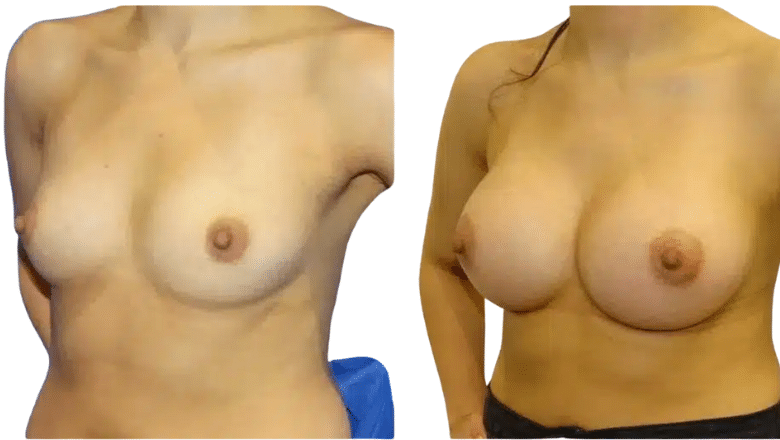
Breast Augmentation From an A or B Cup to a C Cup
Going from an A cup to a C cup, or from a B to a C, is one of the most common changes requested. A two-cup increase usually looks natural on women with a moderate chest width and some existing breast tissue. Women with very little tissue, or very tight skin, may be advised to choose a slightly smaller implant for a softer, more natural result and a lower risk of the implant edges showing (rippling). If your breasts have also dropped, the surgeon will check whether you need a lift as well, as an implant alone cannot raise a low nipple.
C Cup Breast Augmentation Before and After Photos
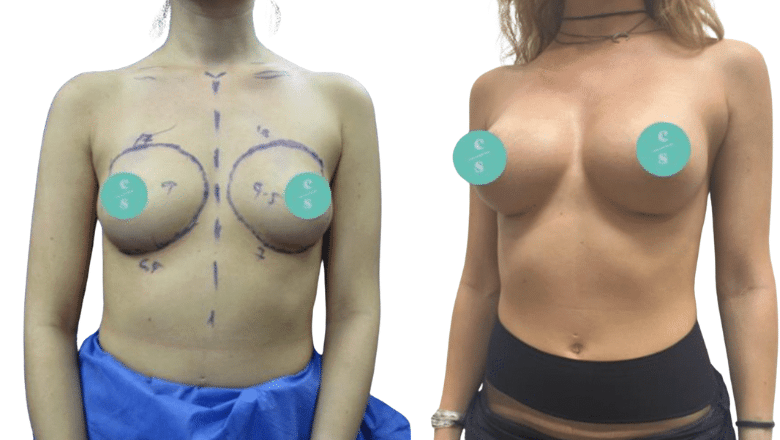
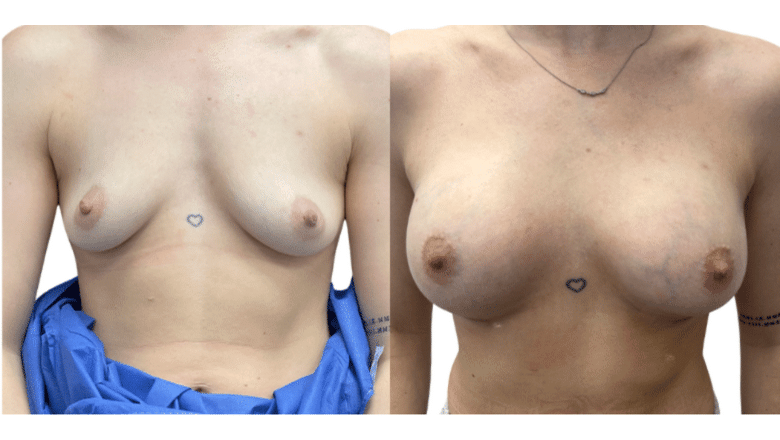
Looking at results on women with a similar starting size and frame to your own gives you a far more reliable idea of what a C cup would look like on you. You can see real Centre for Surgery patients in our breast augmentation before and after photos, and your surgeon can show you further results at consultation.
Risks, Recovery and Breastfeeding After C Cup Breast Augmentation
Breast augmentation at Centre for Surgery is performed as a day case under TIVA (total intravenous anaesthesia). Most people take one to two weeks off work, and strenuous exercise and heavy lifting are usually avoided for around six weeks. Your aftercare includes a wound check at 7–10 days, a surgeon review at six weeks and an assessment at three months. Our breast augmentation recovery guide sets out each stage.
Before surgery you will be asked to stop smoking for four weeks before and four weeks after the operation, and to stop aspirin two weeks beforehand. If you have recently had a baby, we recommend waiting at least three months after completely stopping breastfeeding, ideally around six, or six months after the birth if you did not breastfeed.
Every operation carries risks. Those specific to implants include capsular contracture, rupture, rippling, changes in nipple sensation and, rarely, breast implant-associated anaplastic large cell lymphoma (BIA-ALCL). The MHRA guidance on breast implants and ALCL ↗ and the NHS guide to breast enlargement ↗ are useful independent sources.
Breastfeeding is usually still possible with implants. In a 2023 meta-analysis in Aesthetic Surgery Journal ↗, 82% of women with breast implants breastfed successfully, compared with 88% of women without implants[9]. If you plan to have children, our guide to whether pregnancy can affect your breast implants is worth reading before you decide on timing.
Can You Get C Cup Breasts Naturally?
No exercise, cream, pump or supplement has been shown to grow breast tissue. Gaining weight can increase breast size, but it is unpredictable and affects the whole body. Chest exercises build the pectoral muscle behind the breast, which can improve the look of the upper chest and your posture, and a well-fitted padded or push-up bra changes how breasts look in clothing. Breast enlargement pumps produce only temporary swelling. Our guides to whether breast enlargement creams and supplements work and how to increase breast size look at the evidence in detail.
Frequently Asked Questions About C Cup Breasts

How big is a C cup?
A C cup means the fullest part of your bust measures about 3 inches more than your ribcage just beneath it. The actual volume depends on the band: a C cup on a 32 band is meaningfully smaller than a C cup on a 38 band.
Is a 34C cup small?
No. A 34C is a moderate size: noticeably fuller than an A or B cup on the same band, without the weight that tends to cause back or shoulder discomfort in much larger sizes. On a petite frame a 34C can look generous, and on a tall, broad frame it can look modest. If your size has only ever been estimated, a professional bra fitting is worth having before you decide anything.
Are 42C breasts big?
A 42C combines a large band with a C cup, so the breasts hold considerably more volume than a 32C or 34C even though the letter is the same. On a 42 band, a C cup usually looks proportionate to the chest rather than large for it. Sister sizes such as 40D and 44B hold a similar volume to a 42C.
Is breast size genetic?
Largely, yes. About 56% of the variation in bra cup size is explained by genes, and around a third of that genetic influence is shared with the genes that affect body weight[1]. Seven specific genetic variants linked to breast size have been identified, several near genes involved in oestrogen signalling and breast development[2].
Can I go from an A cup to a C cup in one operation?
Usually, yes, if your chest width and skin can accommodate the implant needed. Women with very little breast tissue or tight skin are sometimes advised to choose a slightly smaller size for a more natural result. Your surgeon will tell you at consultation whether a C cup is realistic for your frame.
Is a C cup implant the same size for everyone?
No. Cup size is relative to band size, and starting breast tissue varies, so two women aiming for a C cup may need noticeably different implant volumes. Implant size is decided individually at consultation, not from a chart.
Can breast augmentation affect breastfeeding?
It can, although most women with implants are still able to breastfeed. In a 2023 meta-analysis, 82% of women with implants breastfed successfully, compared with 88% of women without[9]. Discuss any plans for pregnancy with your surgeon before surgery.
How long is recovery after breast augmentation?
Most people return to desk-based work after one to two weeks and avoid strenuous exercise and heavy lifting for around six weeks. Implants continue to soften and settle for several months, so the final shape is usually judged at around three to six months.
C Cup Breast Augmentation at Centre for Surgery
At Centre for Surgery, breast augmentation is performed by GMC-registered surgeons who specialise in breast surgery, at our hospital at 95–97 Baker Street, which is rated Good overall by the Care Quality Commission. The surgeon who assesses you at consultation is the surgeon who performs your operation, and implant size and type are decided around your own anatomy rather than a fixed target. We recommend a two-week cooling-off period between consultation and surgery.
Your initial consultation is £100, redeemable against the cost of your procedure if you go ahead, and finance is available, subject to status. Guide prices are in our breast augmentation cost guide. To book, call 020 7993 4849 or complete the form below.

References
- Wade TD, Zhu G, Martin NG. Body mass index and breast size in women: same or different genes? Twin Research and Human Genetics 2010;13(5):450–454. doi:10.1375/twin.13.5.450 ↗
- Eriksson N, Benton GM, Do CB, et al. Genetic variants associated with breast size also influence breast cancer risk. BMC Medical Genetics 2012;13:53. doi:10.1186/1471-2350-13-53 ↗
- Hassinger TE, Mehaffey JH, Knisely AT, et al. The impact of bariatric surgery on qualitative and quantitative breast density. The Breast Journal 2019;25(6):1198–1205. doi:10.1111/tbj.13430 ↗
- Mallucci P, Branford OA. Concepts in aesthetic breast dimensions: analysis of the ideal breast. Journal of Plastic, Reconstructive & Aesthetic Surgery 2012;65(1):8–16. doi:10.1016/j.bjps.2011.08.006 ↗
- Kerrigan CL, Collins ED, Striplin D, et al. The health burden of breast hypertrophy. Plastic and Reconstructive Surgery 2001;108(6):1591–1599. doi:10.1097/00006534-200111000-00024 ↗
- McGhee DE, Steele JR. Optimising breast support in female patients through correct bra fit. A cross-sectional study. Journal of Science and Medicine in Sport 2010;13(6):568–572. doi:10.1016/j.jsams.2010.03.003 ↗
- Seth I, Bulloch G, Gibson D, et al. Autologous fat grafting in breast augmentation: a systematic review highlighting the need for clinical caution. Plastic and Reconstructive Surgery 2024;153(3):527e–538e. doi:10.1097/PRS.0000000000010614 ↗
- Collins ED, Kerrigan CL, Kim M, et al. The effectiveness of surgical and nonsurgical interventions in relieving the symptoms of macromastia. Plastic and Reconstructive Surgery 2002;109(5):1556–1566. doi:10.1097/00006534-200204150-00011 ↗
- Chen J, Zhu XM, Huynh MNQ, McRae M. Breastfeeding outcome and complications in females with breast implants: a systematic review and meta-analysis. Aesthetic Surgery Journal 2023;43(7):731–740. doi:10.1093/asj/sjad027 ↗






