


In this guide19 sections
- Key Points
- What Is Hip Liposuction?
- Does Lipo on the Hips Work?
- Why Do Women Store Fat on Their Hips?
- Am I a Good Candidate for Hip Liposuction?
- Which Areas Are Treated With Hip Liposuction?
- How Is Hip Liposuction Done?
- Is Hip Liposuction Painful?
- Hip Liposuction Before and After
- Hip Liposuction Recovery: What to Expect
- What Are the Risks and Side Effects of Hip Liposuction?
- Will Hip Liposuction Leave Loose Skin?
- Is Hip Liposuction Permanent?
- Hip Liposuction vs Other Hip Contouring Options
- How Much Does Hip Liposuction Cost in the UK?
- What Happens at a Hip Liposuction Consultation?
- Frequently Asked Questions
- Hip Liposuction in London
- References
Key Points
- What is hip liposuction? A day-case operation that permanently removes stubborn fat from the hips, and usually the flanks (love handles) beside them, through 3–5 mm incisions. It reshapes the outline of the hips rather than reducing your weight.
- Does lipo on the hips work? Yes, for fat. In a 2011 randomised trial in Obesity ↗, the treated thigh area stayed slimmer a year later. It cannot tighten loose skin, and it does not fill hip dips.[2]
- Who is it for? Adults near a stable, healthy weight (BMI of 30 or below is usual) with firm, elastic skin and a pocket of fat that diet and exercise have not shifted.
- Recovery: most people return to desk work within two to five days, wear a compression garment for six weeks, and see the final result at three to six months.
- Safety: in a 2017 study of 31,010 procedures in Aesthetic Surgery Journal ↗, liposuction on its own had a major complication rate of 0.7%, and combining it with other operations raised the risk.[1]
- Costs depend on how many areas are treated and are confirmed in writing after a face-to-face consultation, with finance available subject to status.
Hip liposuction, also called lipo on the hips or hip lipo, is one of the most frequent requests at a body contouring consultation. Many women store fat on the hips and outer thighs however much they exercise, and it often sits alongside the pockets known as love handles. This guide explains what liposuction can and cannot do for the hips, who is a good candidate, how the operation and recovery work, and how it compares with the alternatives.
At Centre for Surgery, hip liposuction is carried out by GMC-registered surgeons in our CQC-regulated hospital on Baker Street. Hip fat so often continues around the waist and back that many women are assessed for 360 liposuction at the same visit, and if you have already searched for how to get rid of saddlebags, you will find the two overlap.
What Is Hip Liposuction?
Hip liposuction removes fat from the sides of the hips, the area between the waist and the top of the thigh. Surgeons often call the area the flanks or the trochanteric region, and the bulge it forms is sometimes described as hip rolls, saddlebags or hip fat. A thin hollow tube called a cannula is passed through tiny incisions to loosen and suction out the fat, and the fat cells removed do not grow back.
It is body contouring, not weight loss. Up to five litres can be removed in one session at Centre for Surgery, though most patients have far less taken from a single area, so the scales barely move while clothes fit differently. Our liposuction page covers what happens to the fat cells in more detail.
Does Lipo on the Hips Work?
For stubborn fat in the right patient, it does. A 2026 systematic review of isolated cosmetic liposuction in Frontiers in Surgery ↗ found that every technique gave comparable fat reduction and contour improvement, patient satisfaction of at least 80%, and serious complications below 0.1%, although the authors caution that the evidence is mixed in quality.[3]
The limits matter just as much. Liposuction removes the fat you can pinch beneath the skin. It does not remove stretch marks, tighten loose skin or smooth cellulite, and it cannot make a hip look wider or rounder than your bones and remaining fat allow. If cellulite is your main concern, our CelluTite page explains a treatment aimed at its structural cause.
Exercise will not do the same job, because the body cannot choose where to lose fat from. In a 2011 randomised trial of abdominal exercise ↗, six weeks of regular training improved muscle endurance but did not change abdominal fat.[5] The same principle applies to the hips: squats and hip abduction exercises build muscle, but they do not selectively shrink the fat layer on top.
Can Liposuction Get Rid of Hip Dips?
Not usually. Hip dips, the shallow inward curve below the hip bone, are mainly set by the shape of your pelvis and where the thigh bone sits, and liposuction removes volume rather than adding it. Taking fat from the hips can sometimes make a dip look more pronounced if the area above it is slimmed and the dip is left unfilled. If the dip is what bothers you, our guide to hip dip surgery explains why fat transfer is the route to a lasting change, and the skinny BBL moves fat from the waist and tummy into the hips and upper buttocks.
Why Do Women Store Fat on Their Hips?
Where you store fat is largely inherited, and hormones shape it further. Oestrogen encourages fat to settle on the hips, buttocks and thighs from puberty, which is why this pattern is far more common in women than in men and often persists at a healthy weight. Pregnancy, the menopause and ageing can all shift fat distribution again, so hip fat is not a sign of poor discipline.
Dieting therefore often shrinks everywhere except the hips. Our guides to the waist-to-hip ratio and the hourglass figure show how much body shape is set by bone and fat storage.
Am I a Good Candidate for Hip Liposuction?
You are more likely to be a good candidate for hip lipo if:
- your weight has been stable for at least three months and is close to a healthy level, and a BMI above 30 may mean liposuction is not suitable;
- you have a defined pocket of fat on the hips or flanks that has not responded to diet and exercise;
- your skin is firm and elastic enough to redrape smoothly;
- you are in good general health, are 18 or over, and can stop smoking for four weeks before and after surgery;
- your expectations are realistic about a change in shape rather than weight.
Timing matters after pregnancy. We advise waiting at least six months after giving birth, and six to twelve months after a caesarean, because weight and fat distribution keep changing. If you are still gaining or losing weight, it is worth waiting, and our guide to liposuction after weight loss explains how long.
Is It Hip Fat or Lipoedema?
Occasionally, what looks like stubborn hip and thigh fat is lipoedema, a long-term condition in which fat builds up symmetrically in the legs and sometimes the arms. It tends to be tender or painful to the touch, bruises easily, feels heavy and barely changes with weight loss. A 2019 review in Obesity ↗ describes it as frequently underdiagnosed and mistaken for ordinary obesity or other leg conditions.[6] If that description sounds familiar, read about our lipoedema treatment pathway before booking cosmetic hip liposuction, because the assessment and goals are different.
Which Areas Are Treated With Hip Liposuction?
Hip liposuction is rarely done on its own area. A good contour depends on how the hips blend into the neighbouring areas, so your surgeon will look at:
- The hips and outer thighs: the saddlebag area, often treated together with thigh liposuction so the line runs smoothly into the leg.
- The flanks: the love handles above the hip bone, where treating the hips alone can leave a visible shelf.
- The back and bra line: see our guide to back liposuction where the fat continues round the torso.
- The abdomen: where the tummy is also full, stomach liposuction completes the waistline.
Areas are counted by anatomical zone, so treating both hips is one zone while the upper and lower abdomen are two. Our overview of the areas that respond to liposuction shows how zones are usually combined, and the body contouring page lists the wider options.
How Is Hip Liposuction Done?
Hip liposuction at Centre for Surgery is a day case, usually lasting one to three hours depending on how many areas are treated. The steps are:
- Your surgeon marks the areas to be treated while you stand, so the contour is planned with gravity in play.
- You are put to sleep with TIVA, or for small areas have local anaesthetic with or without sedation.
- Tumescent fluid containing local anaesthetic is injected to firm the tissue and limit bleeding.
- The fat is loosened and removed through 3–5 mm incisions placed in skin folds, and a final pass smooths the layer under the skin.
- Dissolvable stitches close the incisions, your compression garment is fitted, and you go home the same day.
Our guide to TIVA anaesthesia explains why we use it for most liposuction.

Power-Assisted or VASER Lipo for the Hips?
Both are available. Power-assisted liposuction uses a vibrating cannula to loosen fat, while VASER liposuction uses ultrasound, which can help in dense, fibrous fat such as that often found on the flanks. They are frequently combined, and our comparison of power-assisted liposuction vs VASER sets out the differences.
A 2025 review in Aesthetic Plastic Surgery ↗ found only five studies comparing ultrasound-assisted with traditional liposuction and little convincing long-term evidence that ultrasound gives better aesthetic results or skin tightening.[4] The surgeon’s judgement and technique matter more than the label. We do not offer laser liposuction; our laser lipo guide explains why, and where skin needs tightening alongside fat removal, BodyTite may be discussed.
Is Hip Liposuction Painful?
Not usually very. You are asleep under TIVA, or numb under local anaesthetic, and the tumescent fluid contains local anaesthetic that eases the first hours. Afterwards the treated areas feel sore, tight and bruised for a few days, a little like the day after a hard workout, and paracetamol is usually enough. Most people are comfortable by the end of the first week. Our guide asks does liposuction hurt? and answers it in full.
Hip Liposuction Before and After
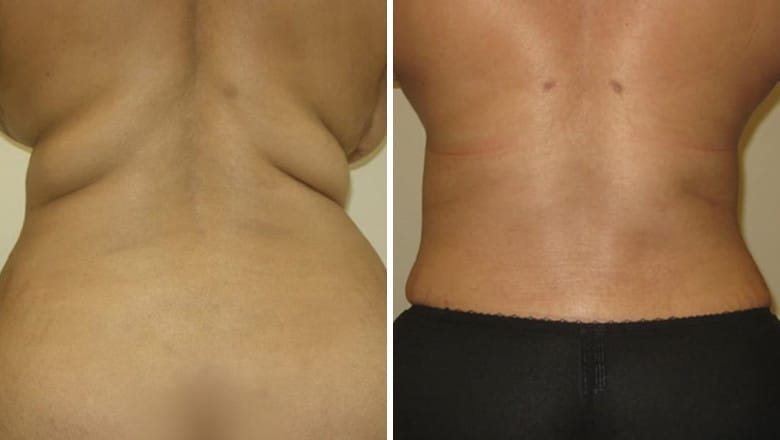
Photographs help you judge what is realistic, though no two bodies are alike. The first shows flank liposuction, the area directly above the hips, and the second shows 360 liposuction of the waist and flanks. Both are Centre for Surgery patients, and results vary. More examples are on our liposuction before and after photos page.

Hip Liposuction Recovery: What to Expect
Recovery is usually described as manageable, though you should plan for it. Our liposuction recovery guide has the full timeline, and the main milestones are these:
- First 24 hours: a responsible adult takes you home and stays with you, and you have your surgeon’s direct number. Reddish fluid may leak from the incisions for 24 to 48 hours, which is leftover tumescent fluid.
- Days 1 to 3: swelling peaks, and these are usually the most uncomfortable days. Walk little and often from day one to lower the risk of clots.
- Days 2 to 5: most people return to desk work, and physical work usually needs one to two weeks.
- Days 7 to 10: a wound check, and driving is usually possible once you are off strong pain relief.
- Four weeks: avoid strenuous exercise and heavy lifting until then.
- Six weeks: return to full exercise after your surgeon review, and the compression garment comes off.
- Three to six months: swelling settles and the final contour shows.
How Long Do You Wear a Compression Garment After Hip Liposuction?
You wear it continuously for six weeks, removing it only briefly to shower. It reduces swelling, supports the healing tissue and helps the skin settle evenly, and taking it off early can affect the contour. Garments are purchased separately and confirmed with you in advance, and our guide to choosing a compression garment for liposuction explains fit.
Why Do My Hips Look Bigger After Liposuction?
Swelling. The treated area can look fuller or uneven for several weeks, and deeper swelling can last three to six months. Lymphatic drainage massage may be advised after multi-area treatment.
What Are the Risks and Side Effects of Hip Liposuction?
Liposuction is safe for most healthy people in a regulated hospital, but no surgery is risk-free. In the 2017 study of 31,010 procedures, liposuction performed alone had a major complication rate of 0.7%, defined as an emergency visit, hospital admission or reoperation within 30 days. The most common were haematoma (0.15%), pulmonary complications (0.1%) and infection (0.1%), and combined procedures carried nearly five times the risk.[1]
Expected effects include bruising, swelling, numbness and tightness. Possible complications include:
- contour irregularity or asymmetry, the commonest aesthetic concern, and occasionally a revision is needed;
- seroma (a fluid collection) or haematoma (a collection of blood);
- infection, and rarely blood clots;
- temporary or occasionally lasting changes in skin sensation.
We limit each session to five litres and operate as a day case, and you need to stop smoking for four weeks before and after surgery, as smoking slows healing. Our guides to liposuction side effects and liposuction scars separate expected effects from complications. Scars are small, placed in skin folds and typically fade to near-invisible over about twelve months.
Will Hip Liposuction Leave Loose Skin?
Liposuction does not cause loose skin, but it can reveal looseness that the fat was hiding. Firm, elastic skin usually retracts over the following months. Where skin has lost elasticity through age, pregnancy or major weight loss, it may not. A small case series from France describes a lift of the outer thigh and hip area for major trochanteric excess after weight loss, which shows how a different operation is sometimes needed.[7]
Your surgeon will test your skin at consultation. If laxity is the bigger problem, a thigh lift or tummy tuck may do more than liposuction, and our guide to loose skin vs fat helps you tell which you have.
Is Hip Liposuction Permanent?
The fat cells removed do not grow back, so the change is lasting in the treated area. The body defends its overall fat store, though. In the 2011 randomised trial of 32 non-obese women, body fat percentage in the lipectomy group was no longer significantly different from controls after a year, with fat returning to the abdomen while the treated thigh region stayed reduced.[2] In practice, a stable weight is what protects your new shape. If you gain weight, the remaining cells enlarge, and because the hips have fewer of them, gain may show elsewhere. Read whether fat can come back after liposuction, our guide to whether liposuction is permanent and our tips on preventing weight gain after liposuction.
Hip Liposuction vs Other Hip Contouring Options
The right option depends on what is creating the hip shape you dislike. Fat responds to liposuction, loose skin to a lift, and a hip dip to fat transfer, so the first job at consultation is to work out which layer is responsible.

- Non-surgical fat reduction: fat freezing and similar treatments reduce small amounts and do not suit larger pockets. See our evidence review of non-surgical liposuction and our overview of liposuction alternatives.
- Liposuction with fat transfer: where you want fewer hip rolls and a fuller upper buttock, a 360 lipo and BBL uses the removed fat, and the Brazilian butt lift page explains who it suits.
- Skin removal surgery: where loose skin is the problem, our liposuction vs tummy tuck comparison explains which front-of-body operation fits.
How Much Does Hip Liposuction Cost in the UK?
The cost of hip liposuction depends mainly on how many anatomical zones are treated and whether you have TIVA or local anaesthetic. Your BMI, the expected operating time and any previous liposuction in the same area also play a part. We do not quote figures in articles. Your price is confirmed in writing after a face-to-face consultation, and our liposuction cost guide explains how pricing is built. Finance is available through the finance options page, subject to status.
What Happens at a Hip Liposuction Consultation?
You meet the surgeon who will operate. They examine your hips, flanks and thighs, test skin elasticity, discuss your goals and medical history, and explain whether liposuction, 360 liposuction, fat transfer or a different operation suits you, including when the answer is that surgery is not right. Our guide on how to prepare for liposuction surgery lists what to do beforehand, and you can read about why patients choose Centre for Surgery and the Baker Street hospital.
Frequently Asked Questions
Can liposuction remove hip fat?
Yes. Liposuction permanently removes fat cells from the hips and flanks, and the area stays slimmer provided your weight stays stable. It treats fat only, so loose skin, cellulite and hip dips need other approaches.
How painful is hip liposuction?
You are asleep or numb during the operation. Afterwards, expect soreness, tightness and bruising for a few days, usually managed with paracetamol. Most people are comfortable by the end of the first week.
How long does it take to recover from hip lipo?
Most people return to desk work in two to five days, avoid strenuous exercise for four weeks and return to full exercise at about six weeks. You wear a compression garment for six weeks, and the final result shows at three to six months.
Who is not a good candidate for liposuction?
Liposuction may not suit people with a BMI above 30, an unstable weight, very loose skin, smoking they cannot stop for four weeks either side of surgery, or unrealistic expectations of weight loss. It is for adults aged 18 or over. If your hip and thigh fat is painful and symmetrical, you should be assessed for lipoedema first.
What happens 10 years after liposuction?
The fat cells removed stay gone, so the treated area usually stays slimmer if your weight is stable. Ageing, pregnancy and weight changes still alter your shape, and gained weight may show in untreated areas.
Is hip liposuction safe?
It is safe for most healthy adults when a GMC-registered surgeon performs it in a regulated hospital, but there are risks, including bruising, contour irregularity, seroma, infection and rarely blood clots. In one large study, major complications after liposuction alone were 0.7%.
Can lipo remove hip dips?
Not normally. Hip dips come from bone structure, and liposuction removes volume rather than filling the dip. Fat transfer to the hips is the option that changes a dip, and your surgeon can say which suits you.
Can I have liposuction on my hips and thighs together?
Yes. Hips, flanks and outer thighs are often treated in one session so the contour blends, with up to five litres removed in total.
What is a cheaper alternative to liposuction?
Non-surgical treatments such as fat freezing cost less per session but remove far less fat and may need repeating. They suit small, pinchable pockets rather than a larger hip bulge. A consultation will say whether they are worth considering.
Hip Liposuction in London
If hip fat has not responded to diet and exercise, a consultation will establish whether liposuction, a combined approach or another operation fits, and what is realistic for your body. Find out more about liposuction at Centre for Surgery.
Phone: 020 7993 4849 | Address: 95–97 Baker Street, Marylebone, London W1U 6RN
Contact us to schedule a consultation
References
- Kaoutzanis C, Gupta V, Winocour J, Layliev J, Ramirez R, Grotting JC, Higdon K. Cosmetic liposuction: preoperative risk factors, major complication rates, and safety of combined procedures. Aesthetic Surgery Journal 2017;37(6):680–694. doi:10.1093/asj/sjw243 ↗
- Hernandez TL, Kittelson JM, Law CK, Ketch LL, Stob NR, Lindstrom RC, et al. Fat redistribution following suction lipectomy: defense of body fat and patterns of restoration. Obesity 2011;19(7):1388–1395. doi:10.1038/oby.2011.64 ↗
- Yang C. Safety and clinical outcomes of contemporary liposuction techniques: evidence from a systematic review. Frontiers in Surgery 2026;13:1892614. doi:10.3389/fsurg.2026.1892614 ↗
- Atieh B, Baajour J, El Merkabaoui H, Makkawi K. Literature review and evidence-based comparative analysis of traditional suction-assisted lipectomy (SAL) vs. ultrasound-assisted liposuction (UAL) reported outcomes. Aesthetic Plastic Surgery 2025;49(16):4648–4655. doi:10.1007/s00266-025-04872-2 ↗
- Vispute SS, Smith JD, LeCheminant JD, Hurley KS. The effect of abdominal exercise on abdominal fat. Journal of Strength and Conditioning Research 2011;25(9):2559–2564. doi:10.1519/JSC.0b013e3181fb4a46 ↗
- Buso G, Depairon M, Tomson D, Raffoul W, Vettor R, Mazzolai L. Lipedema: a call to action! Obesity 2019;27(10):1567–1576. doi:10.1002/oby.22597 ↗
- Ruffenach L, Bruant-Rodier C, Robert E, Bodin F, Dissaux C. Trochanteric under gluteus lift or bodylift, technique for massive trochanteric lipodystrophy: about 11 cases. Annales de Chirurgie Plastique Esthétique 2017;62(4):295–302. doi:10.1016/j.anplas.2017.05.006 ↗







