


In this guide16 sections
- Key Points
- Can You Have Rhinoplasty and Blepharoplasty at the Same Time?
- Is It Safe to Have Eyelid Surgery and a Nose Job at the Same Time?
- Why Combine a Nose Job With Eyelid Surgery?
- What Do Blepharoplasty and Rhinoplasty Each Involve?
- Who Is a Good Candidate for Combined Rhinoplasty and Blepharoplasty?
- How Long Is Recovery After Rhinoplasty and Blepharoplasty?
- What Are the Risks of Rhinoplasty and Blepharoplasty Together?
- What Should You Not Do Before Blepharoplasty and Rhinoplasty?
- Will I Look Older or Different After Eyelid Surgery and a Nose Job?
- What Else Can Be Combined With a Nose Job and Eyelid Surgery?
- How Much Do Rhinoplasty and Blepharoplasty Cost Together?
- What Happens at a Consultation for Combined Eyelid and Nose Surgery?
- Frequently Asked Questions
- Combined Eyelid and Nose Surgery in London
- References
Key Points
- Can you have rhinoplasty and blepharoplasty at the same time? Yes. A nose job and eyelid surgery are routinely planned as one day-case operation under TIVA, provided the surgeon is satisfied that the total operating time and your general health make it safe.
- Safety depends on operating time and the person. A 2025 review of 42,720 outpatient plastic surgery cases found that combined procedures and longer operations carried more risk, which is why the surgeon decides case by case[1].
- One anaesthetic, one recovery. Expect about 7 to 10 days off work, the nasal splint and eyelid stitches out at around one week, and full exercise at about six weeks.
- Glasses and contact lenses need planning. Contact lenses stay out for 2 to 3 weeks after eyelid surgery, and glasses cannot rest on a healing nose for about six weeks.
- Results are never guaranteed. Published series report revision rates of roughly 3% to 7% after primary rhinoplasty[3], so a realistic discussion matters as much as the operation.
- Cost is confirmed in writing after consultation, and finance options are available.
Rhinoplasty and blepharoplasty are two of the most frequently combined facial operations, and the question behind most searches is simple: can they safely be done in one go? Our surgeons regularly plan blepharoplasty (eyelid surgery) and rhinoplasty (nose reshaping) together, because the eyes and the nose sit at the centre of the face and changing one often changes how the other reads.
This guide explains when the two can be combined, what the evidence says about safety, how recovery works with both areas healing at once, and when it is wiser to stage them. If you are still deciding which eyelid operation you need, start with our comparison of upper vs lower blepharoplasty, and for the wider picture see combining cosmetic surgery procedures.
Can You Have Rhinoplasty and Blepharoplasty at the Same Time?
Yes, in most healthy adults. Rhinoplasty and blepharoplasty are performed on different areas, use different incisions, and can be done one after the other in a single operation. At Centre for Surgery the combined operation is done as a day case at our CQC-regulated Baker Street hospital, with a consultant anaesthetist, under TIVA (total intravenous anaesthesia).
The anaesthetic matters. Upper eyelid surgery on its own is often done under local anaesthetic, with or without sedation, while rhinoplasty is done under TIVA, so once the two are combined TIVA covers both. You go home the same day with a responsible adult staying with you for 24 hours.
The possible combinations are:
- Nose job plus upper eyelid surgery: for hooded or heavy upper lids, sometimes called an eyelid lift.
- Nose job plus upper and lower eyelid surgery: for hooded lids and under-eye bags together, sometimes described as eye bag removal.
- Septorhinoplasty plus eyelid surgery: when the nose also needs a breathing correction, covered on our septorhinoplasty page.
Some patients prefer to have the operations months apart, which is a reasonable choice.
Is It Safe to Have Eyelid Surgery and a Nose Job at the Same Time?
For a suitable patient, combined facial surgery is a well-established approach, but “safe” is not a blanket answer. No trial has compared eyelid and nose surgery done together against the same operations done separately, so the evidence comes from wider studies of outpatient plastic surgery. The largest is a 2025 review of 42,720 consecutive outpatient cases in Plastic and Reconstructive Surgery ↗. It found an overall complication rate of 0.74%, but combined procedures were the strongest predictor of blood clots (venous thromboembolism) and of unplanned hospital admission, followed by longer operating time. Its authors suggested extra monitoring for planned combined procedures, operations over three hours and patients with a higher body mass index[1].
Two points keep that in proportion. The cases covered face, breast and body surgery, and the strongest warning related to combinations involving abdominal surgery. It still explains why a responsible surgeon does not combine operations automatically, and why your health, body mass index and planned operating time are assessed first.
How Long Can Combined Surgery Safely Take?
There is no single legal or clinical limit, so the surgeon and anaesthetist set one for each patient. As a guide, the operating times on our service pages are 1 to 1.5 hours for upper eyelids, 2.5 to 3 hours for combined upper and lower eyelids, and 1.5 to 3 hours for a nose job, longer for revision work. Added together, a combined operation can therefore run from roughly 2.5 to 6 hours. When the plan would push beyond what is comfortable, the sensible answer is to split the work into two stages instead of lengthening one anaesthetic.
Does TIVA Make Combined Surgery Safer?
TIVA keeps you asleep with an intravenous anaesthetic drug rather than a gas, and its main advantage is a smoother recovery. A 2024 meta-analysis of 317 randomised trials in EClinicalMedicine ↗ found that TIVA and inhaled anaesthesia gave similar mortality and organ complications, but TIVA cut postoperative nausea and vomiting (relative risk 0.61) and emergence delirium[2]. Less sickness matters after eyelid and nose surgery, where retching can raise pressure in the face. Our guide to anaesthesia for cosmetic surgery explains what to expect on the day.
Why Combine a Nose Job With Eyelid Surgery?
People who choose a combined operation usually give these reasons:
- One anaesthetic. You are put to sleep once instead of twice.
- One recovery period. Swelling and bruising from both areas settle on the same timetable, so you plan one stretch away from work and social life.
- Facial balance. The nose and eyes frame each other, and planning them together lets the surgeon judge the proportions of the whole central face. Our guide to combining facial plastic surgery procedures explains the principle.
The trade-offs are real too: a longer anaesthetic, swelling around the eyes and nose at once, a more demanding first week, and the glasses and lens problem described below.
What Do Blepharoplasty and Rhinoplasty Each Involve?

What Does Blepharoplasty Treat?
Blepharoplasty removes or repositions excess skin and fat around the eyes. Upper eyelid surgery treats droopy or hooded lids through a fine incision hidden in the natural lid crease. Lower eyelid surgery treats under-eye bags, either through the inside of the lid (transconjunctival, no external scar) or just below the lashes. If heavy lids are really caused by a low brow, a brow lift may be the right operation instead, and our brow lift vs blepharoplasty guide explains how to tell. Men and women are assessed differently, as our blepharoplasty for men and women article explains.
What Does Rhinoplasty Treat?
Rhinoplasty reshapes the bridge, tip, width or profile of the nose, and can correct some breathing problems when the septum is straightened at the same time. The surgeon works through an open approach (a small incision across the columella) or a closed approach (all incisions inside the nostrils), and the choice depends on the changes planned. Read who is not suitable for rhinoplasty and realistic rhinoplasty expectations before a consultation. If an earlier nose operation did not go as hoped, revision rhinoplasty is planned differently, and combining it with other surgery needs particular care.
Who Is a Good Candidate for Combined Rhinoplasty and Blepharoplasty?
At consultation your surgeon checks several things before recommending a combined operation. These mirror the suitability criteria on our service pages:
- You are aged 18 or over, in good general health, with a stable weight. Our minimum age for rhinoplasty guide explains why we say 18.
- You are a non-smoker, or can stop smoking and vaping for four weeks before and four weeks after surgery.
- You have no severe dry eye, uncontrolled thyroid eye disease or active eye infection, and no active sinus infection or recent nasal injury.
- Your concerns are specific and your expectations realistic, and you can arrange time to recover and a responsible adult for the first 24 hours.
A two-week cooling-off period from consent is recommended before any surgery is booked.
When Is It Better to Have the Operations Separately?
Staging is usually wiser when the combined operating time would be long, when a health condition makes a long anaesthetic less suitable, when the nose needs complex or revision work, or when you are unsure about one of the two operations and would rather see the first result before deciding.
How Long Is Recovery After Rhinoplasty and Blepharoplasty?
Plan for the slower of the two timelines. Most people are back at desk work 7 to 10 days after surgery, and a gym routine returns at about six weeks. Swelling at the nose tip keeps refining for up to a year, as our guide to rhinoplasty swelling explains.

What Does the First Fortnight Look Like?
- Day 0: you wake in our recovery unit, spend three to four hours with one-to-one recovery nursing, and go home with a responsible adult. Your nose is splinted and your eyes feel tight.
- Days 2 to 4: bruising and swelling peak. Cold compresses, rest and a raised head help.
- Around day 7: the nasal splint comes off and eyelid stitches are removed at your review.
- Days 7 to 10: most people return to desk work, using concealer if needed. Do not blow your nose for two weeks.
- Weeks 2 to 3: light exercise resumes and contact lenses can usually go back in once your surgeon agrees.
Full recovery guidance for each operation is in our rhinoplasty recovery and blepharoplasty recovery guides.
How Long Do I Have to Sleep Sitting Up After Blepharoplasty?
After eyelid surgery, sleep on your back with your head raised on two pillows for the first week. After a nose job the usual advice is a little longer, with the head above the level of the heart for about two weeks, and avoiding side or front sleeping for around six weeks so nothing presses on the healing nose. Following the rhinoplasty advice covers both. Our guide to how to sleep after rhinoplasty has practical tips.
Why Can’t You Bend Over After Blepharoplasty?
Bending, lifting and straining raise blood pressure in the head, which increases swelling and the risk of bleeding around healing incisions. For the first couple of weeks, bend your knees instead of stooping and avoid heavy lifting. This applies equally after a nose job.
When Can I Wear Glasses and Contact Lenses?
This is the practical snag of combining the two. After eyelid surgery on its own, glasses can be worn straight away and contact lenses stay out for 2 to 3 weeks. After a nose job, glasses cannot rest on the healing bridge for about six weeks. Together, that leaves a gap of two to three weeks when neither is ideal. If you rely on strong correction, tell your coordinator early so your surgeon can talk through options, and see our guide on wearing glasses after rhinoplasty.
When Can I Wear Make-Up?
Face make-up is usually fine from about two weeks once the incisions have closed, and eye make-up a little later. Our guide to make-up after eyelid surgery gives the detail.
What Are the Risks of Rhinoplasty and Blepharoplasty Together?
Every operation carries risks, and combining two adds a longer anaesthetic and more healing at once. Our guides cover rhinoplasty risks and the risks and complications of eyelid surgery in full. The points that matter most for a combined operation are below.
Bruising and Swelling
Bruising around the eyes is expected after both operations and can track down onto the cheeks. Some surgeons use tranexamic acid, a medicine that reduces bleeding, to limit it. A 2026 systematic review of five randomised trials in Aesthetic Plastic Surgery ↗ covering 604 blepharoplasty patients found less bleeding, bruising at one week and swelling with tranexamic acid, with no infections or wound complications reported[6].
Dry Eyes and Lower Eyelid Position
Dry, gritty or watery eyes are common in the first weeks and usually settle, as our guides to dry eyes after blepharoplasty and watery eyes after blepharoplasty explain. The complication surgeons guard against most carefully is the lower lid being pulled down or outwards (retraction or ectropion). A 2026 review notes that the transconjunctival approach can preserve the supporting muscle of the lid and so lessen that risk[7], while a 2021 review describes how lid malposition, once common, is now much reduced by careful planning, conservative skin removal and support of the outer corner[8].
Revision Rates After Rhinoplasty
Even in skilled hands, some noses need a second operation. In a 2025 series of 594 consecutive primary rhinoplasties in Aesthetic Plastic Surgery ↗ with at least a year of follow-up, revision rates were 3.3% to 7.3% depending on the technique, and complication rates 10.6% to 13.4%[3]. A separate series of 734 primary rhinoplasties reported a 6% revision rate, mostly for small contour adjustments to the bridge[4], and a pooled analysis of 4,482 septorhinoplasty patients needing rib cartilage grafts gave 5.0% revision and 4.0% dissatisfaction[5]. These are not Centre for Surgery figures and they relate to the nose, but they show why a candid conversation about limits belongs before any combined plan.
What Should You Not Do Before Blepharoplasty and Rhinoplasty?
Preparation affects healing. Our preparing for cosmetic surgery guide has the full list, and the essentials are these:
- Do not smoke or vape for at least four weeks before and four weeks after surgery.
- Do not take aspirin, ibuprofen or blood-thinning supplements in the two weeks before surgery unless your surgeon says otherwise, and flag any prescribed blood thinners.
- Do not go ahead with a cold or sinus infection. Tell us if you develop one in the week before and we will reschedule.
- Tell your surgeon about any fillers or anti-wrinkle injections you have had around the eyes, brow or nose, as they can affect planning.
Will I Look Older or Different After Eyelid Surgery and a Nose Job?
In the first weeks swelling can make the eyes and nose look heavier than before, and some people feel they look older or odd while it settles. That is expected and fades. Over the longer term, a good result looks rested rather than operated on, though eyelid surgery does not stop ageing. Our guides to whether eyelid surgery results are permanent, how long blepharoplasty lasts and whether a nose job is permanent cover this honestly. Slight differences between the two eyes are normal, and eyelid surgery for asymmetrical eyes has its own limits.
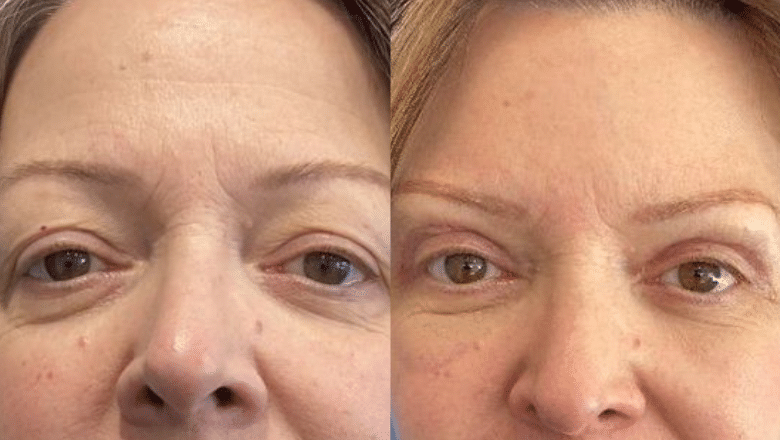

More cases are in our blepharoplasty before and after gallery and rhinoplasty before and after photos.
What Else Can Be Combined With a Nose Job and Eyelid Surgery?
Many patients ask whether more can be added, and the same rules on operating time and health apply:
- Brow lift: when a low brow contributes to heavy lids, a brow lift treats the cause.
- Facelift or mini facelift: see blepharoplasty and mini facelift at the same time, and our facelift page.
- Lip lift: often combined with rhinoplasty through the same nasal base incision. Does a lip lift change nose shape? It can subtly change how the nose and upper lip relate, which our guide to whether a lip lift changes your nose and the lip lift page explain.
- Septoplasty: a breathing correction frequently added to a nose job, covered in can rhinoplasty and septoplasty be done together.
- Anti-wrinkle injections and dermal fillers: non-surgical finishing touches, usually planned once swelling has settled. See anti-wrinkle injections and dermal fillers.
If you would rather not have surgery on the nose, non-surgical rhinoplasty can be paired with eyelid surgery for small contour changes.
How Much Do Rhinoplasty and Blepharoplasty Cost Together?
The price depends on whether you need upper, lower or both eyelids, the type of nose work, the anaesthetic and the operating time, so it is confirmed in writing after consultation. Combining the operations usually means one theatre session and one anaesthetic instead of two, which can reduce the facility and anaesthetic elements compared with staging. Our blepharoplasty cost and rhinoplasty cost guides explain what drives each price, and our finance options page sets out how to spread the cost with Chrysalis Finance, subject to status.
What Happens at a Consultation for Combined Eyelid and Nose Surgery?
You meet a GMC-registered surgeon who examines your eyelids, brow and nose, discusses what you want to change, and tells you honestly whether the combined plan is right. The surgeon who assesses you at consultation is the surgeon who operates, and our team will explain anaesthesia, recovery, risks and the cooling-off period. If you are comparing options abroad, read blepharoplasty abroad and nose job in Turkey first, and see how to choose a nose job surgeon in London.
Frequently Asked Questions
Can rhinoplasty and blepharoplasty be done together?
Yes, in suitable patients. A nose job and eyelid surgery can be done in one day-case operation under TIVA, as long as the surgeon and anaesthetist judge the total operating time and your health safe. Some people stage them instead.
Can you have upper and lower eyelid surgery at the same time?
Yes. Upper and lower lids are normally treated in one operation so everything heals together, taking about 2.5 to 3 hours. Adding a nose job lengthens the operation, so your surgeon plans the total time carefully.
How long do I have to sleep sitting up after blepharoplasty?
Sleep on your back with your head raised on two pillows for at least the first week. After a nose job, keep the head above the heart for around two weeks.
Why can’t you bend over after blepharoplasty?
Bending and straining raise blood pressure in the face, which can increase swelling and bleeding around fresh incisions. Bend your knees instead and avoid heavy lifting for the first couple of weeks.
Does a lip lift change nose shape?
A lip lift does not reshape the nose, but shortening the upper lip changes the proportions between nose and lip and can slightly alter the look of the nostril base, so surgeons often plan it alongside rhinoplasty.
Can you get eyelid surgery more than once?
Yes, though repeat surgery is more complex and planned conservatively. Upper eyelid results typically last 7 to 10 years, as skin keeps ageing. Corrective work is covered by our revision blepharoplasty service.
What should you not do before blepharoplasty?
Avoid smoking and vaping for four weeks before surgery, pause aspirin, ibuprofen and blood-thinning supplements for two weeks unless advised otherwise, and report any cold or sinus infection.
How many years does a blepharoplasty take off?
There is no reliable measure. The aim is a more rested, open look rather than a number of years, and the face keeps ageing naturally afterwards.
Combined Eyelid and Nose Surgery in London
If you are considering rhinoplasty and blepharoplasty together, a consultation with a GMC-registered surgeon will establish whether one operation or two stages suits your face, your health and your recovery plans. See also our overview of plastic surgery guides, our clinic FAQs and why choose Centre for Surgery.
Phone: 020 7993 4849 | Address: 95–97 Baker Street, Marylebone, London W1U 6RN
Contact us to schedule a consultation
References
- Rohrich RN, Brown T, Brown S, Burns J, Jejurikar S, Meade R, Rohrich RJ. Three decades of outpatient plastic surgery safety: a review of 42,720 consecutive cases. Plastic and Reconstructive Surgery 2025;156(1):49–61. doi:10.1097/PRS.0000000000011942 ↗
- Kampman JM, Hermanides J, Hollmann MW, et al. Mortality and morbidity after total intravenous anaesthesia versus inhalational anaesthesia: a systematic review and meta-analysis. EClinicalMedicine 2024;72:102636. doi:10.1016/j.eclinm.2024.102636 ↗
- Tarragona R, Mirra C. The process of single surgeon through structural and dorsal preservation in primary rhinoplasty: a 594 case series with one-year follow-up. Aesthetic Plastic Surgery 2025;49(12):3407–3416. doi:10.1007/s00266-024-04496-y ↗
- Guilarte R, Malzone G. Optimizing closed-approach preservation rhinoplasty by ultrasonic piezo-assisted techniques for enhanced precision. Aesthetic Surgery Journal 2025;45(4):347–358. doi:10.1093/asj/sjaf006 ↗
- Jullamusi W, Kowitwibool K, Mungmee A, Piyananthasomdee P. Adverse outcomes and complications of autologous versus homologous costal cartilage grafts in septorhinoplasty: a systematic review and meta-analysis. Aesthetic Surgery Journal 2026. doi:10.1093/asj/sjag131 ↗
- ElAbd R, Richa Y, Pu L, Hiyzajie T, Jabori S, Safran T, Gilardino M. Evaluation of the safety and efficacy of tranexamic acid use in blepharoplasty: a systematic review of randomized controlled trials. Aesthetic Plastic Surgery 2026;50(13):4816–4828. doi:10.1007/s00266-026-05850-y ↗
- Fedok FG. Transconjunctival lower blepharoplasty. Facial Plastic Surgery Clinics of North America 2026;34(1):131–143. doi:10.1016/j.fsc.2025.08.005 ↗
- Cakmak O, Emre IE. An update on subciliary lower eyelid blepharoplasty. Facial Plastic Surgery 2021;37(2):198–204. doi:10.1055/s-0041-1724112 ↗







