


In this guide16 sections
- Key Points
- Can a Facelift Look Natural?
- Why Do Some Facelifts Look Pulled or Overdone?
- What Is the Most Natural Looking Facelift?
- How Do You Avoid a Pulled Look After a Facelift?
- Why Does Facial Volume Matter for a Natural Facelift?
- What Is the Ideal Age for a Natural Looking Facelift?
- Natural Looking Facelift Before and After Photos
- Is a Natural Looking Facelift Safe? Risks to Know About
- How Long Until a Facelift Looks Natural?
- Can You Get a Natural Facelift Without Surgery?
- How Long Does a Natural Looking Facelift Last?
- How Do You Choose a Surgeon for a Natural Facelift?
- Frequently Asked Questions
- Natural Looking Facelift in London
- References
Key Points
- Can a facelift look natural? Yes. A natural looking facelift lifts the deeper tissues of the face and lets the skin settle back without tension, instead of pulling the skin tight.
- The pulled look has identifiable causes: skin-only lifting, an over-tight or sideways pull, lost facial volume that is ignored, and a neck left untreated beneath a lifted jawline.
- Technique is matched to your face. A SMAS facelift suits most people, a deep plane facelift suits heavier faces and deeper folds, and a mini facelift suits early jowls.
- Volume matters as much as lift. In a 2020 randomised trial, patients who had fat grafting alongside a midface lift needed fewer further procedures.
- Judge a result at three to six months, not in the first weeks. Swelling, tightness and a slightly full face are normal early on and settle with time.
- No surgeon can promise a result, but careful assessment, realistic goals and a surgeon who works on the deeper layer make a natural outcome far more likely.
The worry behind most searches for a natural looking facelift is a simple one: will I look like myself, or like someone who has had surgery? It is a fair question, and the honest answer is that it depends on how the operation is planned and performed. A modern facelift repositions the deeper supporting layer of the face rather than stretching the skin, and that single difference explains most of the gap between a result nobody notices and one everybody does.
This guide explains what makes a facelift look natural or pulled, how the main techniques compare, why volume and the neck matter, how long a result takes to settle, and the risks you should weigh. If your face and jawline are your main concern, a deep plane facelift or a mini facelift may come up at consultation, and our guide to the types of facelift sets out where each one fits.
Can a Facelift Look Natural?
Yes, and for most people having surgery today it does. A natural looking facelift does not aim to change your face. It aims to put the tissues that have drifted downwards back where they sat years earlier, so friends say you look well rested rather than asking what you have had done.
The evidence supports that aim. In a 2012 study of 60 patients in Archives of Facial Plastic Surgery ↗, independent raters judged people to look about seven years younger after face and neck lift surgery than before it, and the effect grew when eyelid and brow surgery were added[1]. Raters were judging age, not naturalness, but the result is consistent with what patients report: a younger face that is still recognisably their own.
What “natural” means is also personal. Some people want nobody to know they have had surgery. Others are happy to be told they look refreshed. Saying clearly which you are is part of getting the result you want, and a good surgeon will plan around it.
Why Do Some Facelifts Look Pulled or Overdone?
The stretched, windswept appearance people dread comes from a small number of avoidable technical choices rather than from facelift surgery itself. Our guide to the signs of a botched facelift covers each in detail, but the common causes are:
- Skin-only lifting. Older facelifts tightened the skin alone. Skin has no real holding strength, so it stretches, scars widen and the face looks flat and pulled.
- A sideways pull. Faces age downwards and forwards, so the lift needs to travel diagonally upwards. Pulling horizontally towards the ears gives the swept-back look.
- Over-tightening. Removing too much skin or closing under tension can distort the earlobe (pixie ear), shift the hairline and flatten the cheeks.
- Ignoring volume. Lifting a face that has also lost fat leaves it taut but hollow.
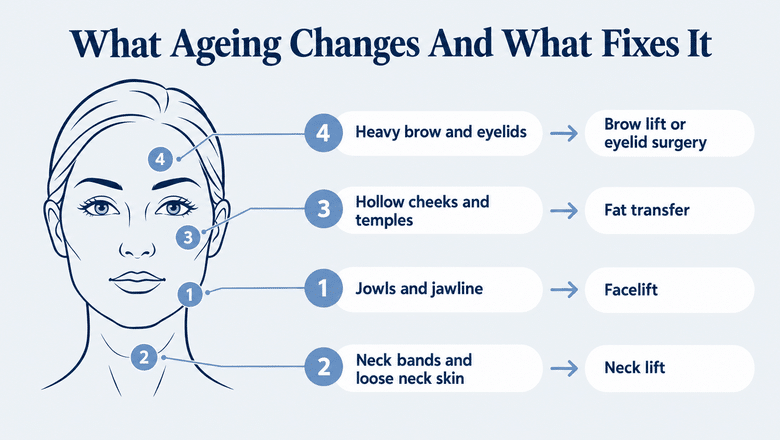
- Treating the face but not the neck. A crisp jawline above loose neck bands looks mismatched.
What causes the windswept look after a facelift?
The windswept look is the result of skin being tightened sideways under tension. The cheeks and mouth corners are dragged towards the ears, the lines around the mouth are stretched and the face loses its normal expression. It is a technique problem, so it is largely avoidable when the deeper layer carries the tension and the skin is simply draped back without being pulled.
Can a pulled facelift be corrected?
Often, partly. A revision facelift can release tension, reposition a displaced earlobe or restore lost volume with fat grafting, although scarring and previous surgery limit what is possible, so the sooner the problem is assessed the better. Our guide on whether you can get a facelift twice explains how second operations are planned.
What Is the Most Natural Looking Facelift?
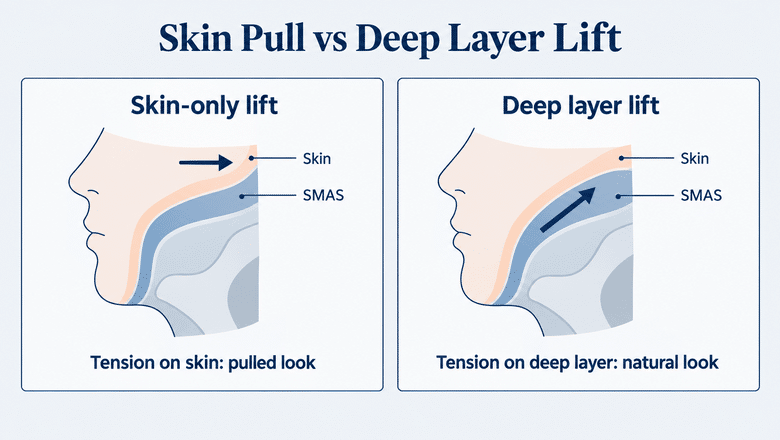
There is no single most natural looking facelift, because the right technique depends on your skin thickness, how far the tissues have dropped and which areas bother you. What the natural-looking techniques share is that they lift the deeper layer, known as the SMAS, and leave the skin without tension.
SMAS facelift for a natural result
A SMAS facelift tightens the layer of muscle and fibrous tissue under the fat, then drapes the skin back without pulling. It is the most common facelift we perform and suits most people with jowls and a softened jawline. It is usually combined with a neck lift, because the face and neck age together. Our guide to muscle repair in a facelift explains what happens to this layer.
Deep plane facelift vs SMAS facelift
A deep plane facelift works beneath the SMAS and releases the retaining ligaments that hold the cheeks and jowls down, so skin, fat and SMAS move together as one unit. That gives stronger correction of deep folds and mid-face descent, which is why it suits thicker skin, heavier faces and some revision cases. For finer skin and moderate laxity, a SMAS lift gives a comparable result with less prolonged swelling. A 2019 meta-analysis of 183 studies in Aesthetic Surgery Journal ↗ concluded that technique should be chosen for the quality of result rather than the complication profile, and found no difference in permanent nerve injury between techniques[2]. Our deep plane vs SMAS facelift comparison goes through the trade-offs.
Is a mini facelift more natural?
A mini facelift is not more natural, only smaller. It treats early jowls through shorter scars and suits people in their forties and fifties whose changes are still modest. Used for the wrong face, it under-corrects. Our guide to facelift vs mini facelift shows how to tell which you need, and the one stitch facelift and endoscopic facelift are further options for very early mid-face change.
How Do You Avoid a Pulled Look After a Facelift?
You avoid a pulled look by choosing a surgeon and a technique that put the lift in the deep layer, plan the direction of pull, restore volume where it has been lost and treat the neck as part of the same plan. Each step is worth understanding before you book.
Let the deep layer carry the tension
When the SMAS is lifted and secured, the skin is closed with little or no tension. Scars then heal finer and the expression stays normal. Ask your surgeon which layer carries the lift. If the honest answer is the skin, that is a reason to look elsewhere.
Lift diagonally, not sideways
Faces fall down and forward, so the repair runs up and back along the same path. A vector planned at consultation, with you sitting upright and the tissues marked, is far more reliable than one decided on the table.
Treat the neck and jawline together
The jawline and neck are read as one unit. Most of our facelift patients have a neck lift in the same operation, and the guide to what a facelift and neck lift can correct explains which changes each one treats.
Watch the hairline and the ears
Incisions are placed in the natural creases in front of the ear and into the hairline behind it, so scars fall where they are hard to see. Your surgeon should explain how they will protect the sideburn hairline and avoid pulling the earlobe downwards. See our guide to facelift scars for what healing looks like.
Do not over-correct
A conservative lift that looks slightly under-done at three months is usually a better outcome than a tight one. The skin can always be tightened later if needed. Tissue removed or stretched too far cannot be put back.
Why Does Facial Volume Matter for a Natural Facelift?
A facelift repositions tissue, but it does not replace what has been lost. As we age, fat in specific compartments of the face shrinks, which hollows the cheeks, temples and under-eyes. A face that has been lifted but not refilled can look tight and a little gaunt, which is the second most common route to an “operated” appearance after skin tension.
A 2020 randomised controlled trial in Aesthetic Plastic Surgery ↗ followed 56 patients who had a midface lift, half with fat grafting at the same operation. At around two years, the lift-and-fill group had higher FACE-Q satisfaction scores, and significantly more of the lift-only group went on to have further procedures[3]. A 2023 review in Plastic and Reconstructive Surgery describes fat loss in specific compartments as a major contributor to structural facial ageing, and autologous fat as a preferred soft-tissue filler for it[4].
Facial fat transfer alongside a facelift
At Centre for Surgery, facial fat transfer can be added under the same anaesthetic to restore the cheeks and temples. Not all transferred fat survives, and how much does varies between people, so volume is usually built up conservatively. Our guides on whether facial fat transfer is permanent and on looking overfilled after fat transfer explain how that is managed.
Dermal fillers and anti-wrinkle injections
For smaller volume changes, dermal fillers and anti-wrinkle injections are also available at Centre for Surgery and can complement surgery, although they do not lift jowls or tighten a neck. If you have filler already, our guide explains whether fillers need dissolving before a facelift. The comparison of fat transfer vs fillers helps when deciding between the two.
Brow and eyelids
A facelift does not treat the upper face. If heavy brows or hooded eyelids add to a tired appearance, a brow lift or blepharoplasty may be suggested. In the 2012 study above, the greatest perceived age reduction came from combining face and neck lift with eyelid and brow surgery[1]. Our guide to procedures that complement a facelift covers the options.
What Is the Ideal Age for a Natural Looking Facelift?
The ideal age is when changes are established enough for a facelift to correct them, but before the skin has lost so much quality that the result looks strained. For most people that is somewhere between the late forties and the sixties. Having a facelift too early tends to lead to an overly smooth look, and the other way round, waiting until the tissues are very loose makes natural correction harder, although it is rarely too late. Our facelift age guide explains why skin quality and tissue descent count for more than your age on paper.
Natural Looking Facelift Before and After Photos
Real photographs tell you more than any description. When you look at facelift before and after photos, check the same lighting, angle and expression in both pictures, look at the ear, hairline and neck as well as the cheeks, and look for photographs taken at least three to six months after surgery. Early photos flatter a result because of residual swelling.
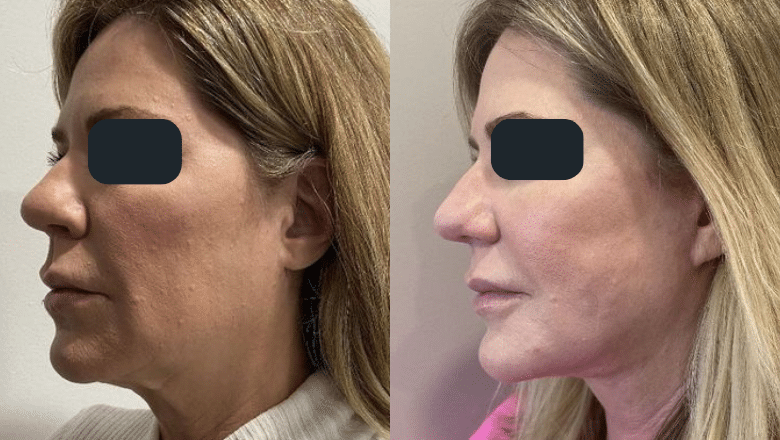
The photograph above shows a patient who had a lower facelift and neck lift, with facial fat grafting to restore volume in the central face and tear trough area, four weeks after surgery. It illustrates the approach this guide describes: lifting the lower face and neck, then restoring volume so the result stays soft. Our full gallery of facelift before and after photos shows more patients, and the guides to the lower facelift and mid facelift show which areas each treats.
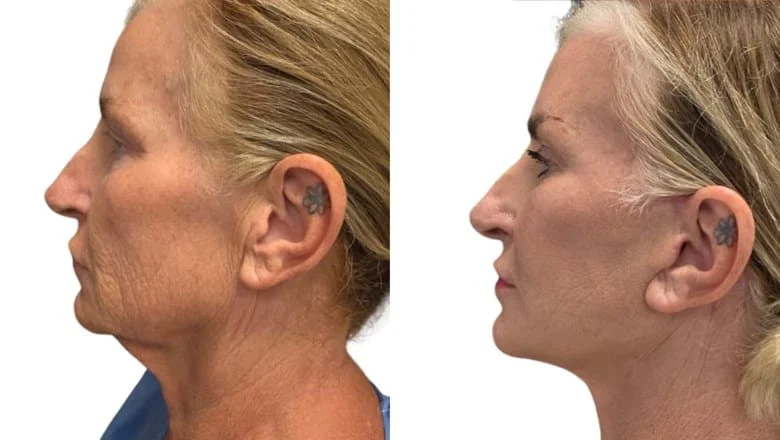
The images in this article are for education only. They show outcomes achieved for other patients and do not guarantee or suggest what you will achieve. Every face and every result is different.
Is a Natural Looking Facelift Safe? Risks to Know About
Facelift surgery is safe when performed by an experienced plastic surgeon in a regulated hospital, but no operation is risk-free, and some risks affect how natural the result looks. Our guide to facelift complications covers each in detail. In summary:
- Haematoma (a collection of blood under the skin) is the most common early problem. A review of 1,078 facelifts at a London hospital found it in 4.2% of patients, and aspirin or anti-inflammatory use, smoking, higher blood pressure and male sex were linked to a higher risk[5]. A 2024 multi-centre review of 3,964 deep plane facelifts reported haematoma in 1.9% and a revision rate of 0.8%, although it relied on surgeons’ own reporting[6].
- Temporary nerve weakness affecting a smile or eyebrow is uncommon and usually settles. In the 2019 meta-analysis it occurred in under 2% of patients even with the most extensive techniques[2].
- Skin healing problems are far more likely in smokers. A review of the evidence reports about a 13-fold higher risk of skin necrosis after facelifts in smokers, and that four weeks without nicotine reduces the risk[7]. We ask for no smoking or vaping for four weeks before and four weeks after surgery.
- Scar widening, asymmetry and contour irregularities are the problems most likely to make a result look unnatural, and some of them can be improved with revision surgery.
Who is not suitable for a facelift?
We will not operate if you cannot stop nicotine for the required period. Uncontrolled diabetes, high blood pressure or thyroid disease, an unstable weight or an active skin condition in the treatment area need addressing first, and unrealistic expectations are a reason not to proceed. If your main concern is skin texture or pigmentation, a facelift is the wrong treatment. Our key questions before facelift surgery help you test whether you are ready.
How Long Until a Facelift Looks Natural?
A facelift takes time to look natural, because swelling and tightness hide the final result at first. At Centre for Surgery, a full facelift with neck lift takes about three to four hours under TIVA (total intravenous anaesthesia), and most people go home the same day with a responsible adult. A deep plane facelift is also done under TIVA, and mini and one stitch facelifts can instead be done under local anaesthetic, with or without sedation.
A typical timeline looks like this:
- Days 1 to 3: tightness, bruising and swelling, which peaks around day three or four.
- About one week: stitches come out. Sleep with your head raised on two pillows and wear the chin support garment for two weeks.
- Weeks 2 to 3: most people return to desk work after 10 to 14 days, or closer to three weeks for public-facing roles, once bruising can be covered with make-up.
- Week 3 onwards: gentle cardio from week three and full exercise from week six.
- Three to six months: swelling settles, in six to eight weeks for the cheeks after a SMAS facelift and up to three months after a deep plane facelift, and scars begin to fade over six to twelve months.
A slightly full or tight face in the first weeks is expected and is not a sign that the result will look overdone. Our facelift recovery guide sets out each stage, and how to prepare for facelift surgery covers what to arrange beforehand.
Can You Get a Natural Facelift Without Surgery?
Non-surgical treatments can soften early changes, but they do not lift jowls or tighten a neck in the way surgery does. Dermal fillers restore volume, anti-wrinkle injections relax lines, and energy-based treatments can firm skin modestly. Our guides to non-surgical facelift procedures, facial skin tightening treatments and facelift alternatives that do not need surgery explain the realistic limits.
Thread lifts are sometimes offered as a middle option. We do not offer them at Centre for Surgery, because the lift they give is small and short-lived compared with a facelift, but our comparison of thread lift vs FaceTite vs facelift sets the options side by side so that you can decide for yourself.
How Long Does a Natural Looking Facelift Last?
A facelift lasts many years, and the face keeps ageing from its new starting point rather than going back to where it was. A SMAS or deep plane lift generally holds longer than a mini or one stitch lift. Sun protection, a stable weight and not smoking all help the result last. The figures often quoted for 10 or 15 years reflect surgical experience rather than long-term trials, so treat them as a guide. Read more in our guides to how long a facelift lasts and what your face looks like 10 years after a facelift, and how to maintain your facelift results.
How Do You Choose a Surgeon for a Natural Facelift?
Choose a surgeon who performs facelifts regularly, who can explain which layer they lift and why, and who shows you their own results at three months or later. Check that they are on the GMC register ↗ and that the hospital is registered with the Care Quality Commission. Our guides on how to choose a plastic surgeon and the six questions to ask before a facelift give you a checklist.
What happens at a facelift consultation at Centre for Surgery?
Your consultation is with a GMC-registered plastic surgeon at our CQC-regulated hospital on Baker Street, and the surgeon who assesses you is the surgeon who operates. They examine skin quality, tissue descent, volume and the neck, discuss which technique suits you and explain the risks. There is a two-week cooling-off period before surgery, costs are confirmed in writing at consultation, and finance options are available subject to status. Men considering surgery can read about the male facelift and the differences between male and female facelifts. For more on emotional readiness, see the psychological impact of facelift surgery and common facelift myths.
Frequently Asked Questions
Can a facelift look natural?
Yes. When the deeper layer carries the lift and the skin is closed without tension, most people look rested and recognisably themselves. The pulled look comes from skin-only lifting, over-tightening or ignored volume loss, all of which are avoidable with good planning.
How do you avoid the pulled look after a facelift?
Choose a surgeon who lifts the SMAS or deeper layer rather than the skin, plans a diagonal rather than sideways pull, restores lost volume where needed and treats the neck at the same time. Be wary of any plan that promises a very tight result.
Is there such a thing as a natural facelift?
There is, although the term describes an approach rather than a single operation. A natural facelift is one planned around your anatomy and kept conservative, whether that is a SMAS facelift, a deep plane facelift or a mini facelift. It will not change who you look like.
How can you tell if someone has had a facelift?
The giveaways are a swept-back or windswept look, an earlobe pulled down onto the cheek, a shifted hairline, visible scars in front of the ear and a face that is tight but hollow. A well-done facelift is hard to spot, because friends tend to notice that you look well rested without knowing why.
Do most people regret having a facelift?
No reliable figure exists, and we would not want to quote one. Regret is most often linked to unrealistic expectations, an over-tight result or lost volume that was not addressed. Choosing a technique that suits your face, being clear about your goals and allowing time to recover reduce that risk considerably.
What is the average age a woman gets a facelift?
Most people who have a facelift are between about 40 and 70, with many in their fifties or early sixties. Age matters less than the changes in your face. Early jowls may suit a mini facelift, while deeper folds and neck laxity suggest a SMAS or deep plane lift.
What disqualifies you from a facelift?
Being unable to stop smoking or vaping for four weeks before and after surgery is the commonest reason. Uncontrolled diabetes, blood pressure or thyroid disease, unstable weight, an active skin condition in the area and unrealistic expectations also need resolving first. Your surgeon will assess this at consultation.
How many years does a facelift make you look younger?
In a 2012 study, raters judged patients to look about seven years younger after a face and neck lift, with a larger effect when eyelid and brow surgery were added[1]. The aim is to look rested rather than to hit a number, and individual results vary.
Natural Looking Facelift in London
If you would like a facelift that keeps you looking like yourself, a consultation will establish which technique, and which additional treatments, suit your face. Find out more about facelift surgery at Centre for Surgery, or read the facelift cost guide for how pricing is explained.
Phone: 020 7993 4849 | Address: 95–97 Baker Street, Marylebone, London W1U 6RN
Contact us to schedule a consultation
References
- Chauhan N, Warner JP, Adamson PA. Perceived age change after aesthetic facial surgical procedures: quantifying outcomes of aging face surgery. Archives of Facial Plastic Surgery 2012;14(4):258–262. doi:10.1001/archfacial.2011.1561 ↗
- Jacono AA, Alemi AS, Russell JL. A meta-analysis of complication rates among different SMAS facelift techniques. Aesthetic Surgery Journal 2019;39(9):927–942. doi:10.1093/asj/sjz045 ↗
- Barone M, Cogliandro A, Salzillo R, et al. Midface lift plus lipofilling preferential in patients with negative lower eyelid vectors: a randomized controlled trial. Aesthetic Plastic Surgery 2021;45(3):1012–1019. doi:10.1007/s00266-020-01971-0 ↗
- Strong AL, Rohrich RJ, Tonnard PL, Vargo JD, Cederna PS. Technical precision with autologous fat grafting for facial rejuvenation: a review of the evolving science. Plastic and Reconstructive Surgery 2024;153(2):360–377. doi:10.1097/PRS.0000000000010643 ↗
- Grover R, Jones BM, Waterhouse N. The prevention of haematoma following rhytidectomy: a review of 1078 consecutive facelifts. British Journal of Plastic Surgery 2001;54(6):481–486. doi:10.1054/bjps.2001.3623 ↗
- Roskies M, Bray D, Gordon NA, et al. Limited delamination modifications to the extended deep plane rhytidectomy: an anatomical basis for improved outcomes. Facial Plastic Surgery & Aesthetic Medicine 2024;26(6):657–664. doi:10.1089/fpsam.2024.0018 ↗
- Knobloch K, Gohritz A, Reuss E, Vogt PM. Nicotine in plastic surgery: a review. Der Chirurg 2008;79(10):956–962. doi:10.1007/s00104-008-1561-3 ↗