


In this guide10 sections
Key Points
- Body contouring implants are solid, soft silicone implants placed under the skin, fascia or muscle to add shape where muscle or bone is underdeveloped or uneven. The main types are pectoral, chest wall, buttock and calf implants.
- They are used both for appearance and for reconstruction: calf implants for one thin leg after clubfoot, polio or injury, and custom-made chest wall implants for pectus excavatum and Poland syndrome.
- Calf implants have one of the strongest track records: a 2022 meta-analysis of 2,455 patients found a 95% satisfaction rate and a 1.3% implant removal rate.
- Buttock implants carry a higher complication rate than other body implants, mainly wound breakdown and seroma, and the risk depends heavily on how deep the implant is placed.
- Unlike fat transfer, an implant keeps a predictable volume, but it is a foreign body: infection, malposition, a palpable edge and, rarely, implant-related lymphoma are possible.
- At Centre for Surgery we offer calf, pectoral, buttock and chest wall implants, including custom implants for pectus excavatum and Poland syndrome.
Most people can change their shape with exercise and weight loss, but some areas respond poorly: calves that will not grow however much you train, a flat or uneven chest, or a sunken breastbone you were born with. Body contouring implants add volume in a predictable way where muscle and fat cannot. This guide explains the different types of body implants, who they suit, how they compare with fat transfer, and what the evidence says about results and risks.
If one area is your main concern, our pages on calf implants, pectoral implants, buttock implants and chest wall implants go into each procedure in detail.
What Are Body Implants?
Body contouring implants are made of solid or semi-solid medical-grade silicone. Unlike breast implants, which contain gel inside a shell, most body implants are a single soft-solid block, which means they cannot leak or rupture in the same way. They come in a range of standard shapes and sizes, and for some areas, particularly the chest wall, they can be custom-made to fit your anatomy from a CT scan.
The surgeon makes a pocket in the right layer, under the skin and fat, under the fascia (the tough sheet over a muscle) or under or within the muscle itself, and places the implant through an incision hidden in a natural crease. The body forms a thin capsule of scar tissue around the implant, which holds it in place.

Types of Body Contouring Implants
Calf implants
Calf implants add bulk and shape to the lower leg, usually to the inner (medial) calf and sometimes the outer calf. They are placed through a short incision in the crease behind the knee. People choose them for small or thin calves that do not respond to training, or to balance one leg that is thinner than the other after clubfoot, polio, injury or a nerve problem.
The evidence for calf implants is reassuring. A 2022 systematic review and meta-analysis of 2,455 patients in JPRAS ↗[1] found that around half had surgery for appearance and half for reconstruction, that 95% were satisfied overall, and that only 1.3% needed their implant removed. Implants placed under the fascia gave the largest increase in volume with the lowest removal rate. Our calf implant recovery guide explains what to expect afterwards.

Real Centre for Surgery patient, photographed at least six months after calf implant surgery. See more in our calf implants before and after photos.
Pectoral implants
Pectoral implants sit under the pectoralis major muscle to give a fuller, more defined upper chest. They are placed through a short incision in the armpit, so there is no scar on the chest itself. They suit men whose chest muscles stay flat despite training, people with one side smaller than the other, and some trans men after top surgery, as our article on pec implants after FTM top surgery explains. With the implant under the muscle, many people return to the gym once healed; see do pectoral implants affect muscle growth and our pectoral implants recovery guide.
Chest wall implants for pectus excavatum and Poland syndrome
Pectus excavatum is a sunken breastbone that makes the centre of the chest look hollow. Poland syndrome is a condition present from birth in which part of the chest muscle on one side is missing, leaving the chest flat or uneven. Both can be very visible and affect confidence, clothing choices and willingness to take part in sport or swim. Our article on what pectus excavatum is explains the condition.
Where the chest deformity does not affect breathing or the heart, a custom-made silicone implant can fill the hollow without the major chest-wall operations used to reshape the bones. In a 2016 series of 401 custom-made pectus implants in Plastic and Reconstructive Surgery ↗[3], there was one infection and three haematomas, a fluid collection around the implant was usual, and implants designed from CT scans by computer gave better correction and higher satisfaction than older plaster-mould implants. An implant improves shape, not heart or lung function. Read more on our pectus excavatum implant and Poland syndrome implant pages.
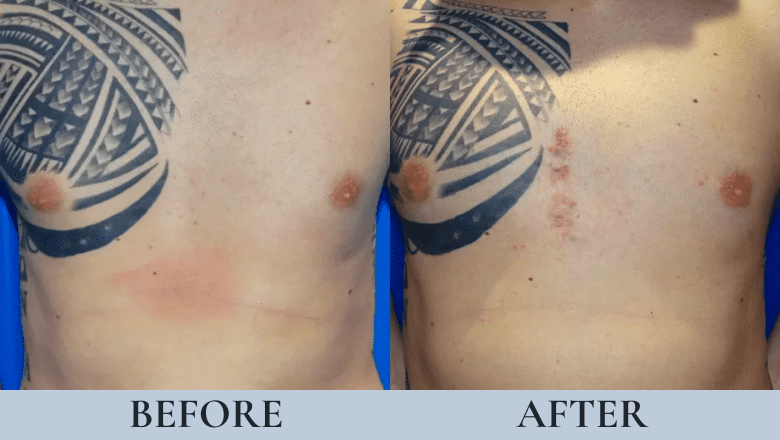
Real Centre for Surgery patient, photographed at least six months after surgery. See more in our pectoral implants before and after photos.
Buttock implants
Buttock implants add projection and shape to the buttocks, for women and men, particularly where there is not enough fat for a fat transfer. Of all body implants they have the highest complication rate, and the depth at which they are placed matters a great deal. A 2025 meta-analysis of 2,682 patients in Plastic and Reconstructive Surgery ↗[2] found that implants placed just under the fascia had the highest rates of seroma and wound breakdown, while placement within or under the muscle had lower complication rates, smooth implants had fewer problems than textured ones, and the overall removal rate was about 1%. We also remove buttock implants, including those placed at other clinics; see butt implant removal and our comparison of BBL vs butt implants.
Arm and shoulder implants
Implants for the biceps, triceps and shoulders exist, but they are uncommon and mainly used to rebuild an arm after injury or muscle loss rather than for appearance[5]. The anatomy around the major arm nerves makes these operations specialised, and they are not covered in this guide.
Body Contouring Implants vs Fat Transfer
Fat transfer uses your own fat, taken by liposuction, to add volume. It feels natural and avoids a foreign body, but some of the fat does not survive and results can be less predictable. Implants give a set, permanent volume and suit people who are slim with little spare fat, or who want more definition than fat can give.
The calf meta-analysis above illustrates the trade-off: satisfaction was 96.7% with implants and 87.2% with fat transfer, but more than half of the fat transfer patients needed a further fat grafting session to reach the result they wanted[1]. For calves, our fat transfer calf augmentation page explains when fat is the better option.
Who Is a Good Candidate for Body Implants?
You may be suitable if:
- you are in good health, at a stable weight and a non-smoker, or willing to stop smoking for four weeks before and four weeks after surgery;
- an area remains underdeveloped or uneven despite exercise, or you have a difference present from birth or after injury;
- you have realistic expectations: implants add shape and volume, but they will not feel exactly like muscle, and they need to be considered a long-term commitment.
Implants are not a substitute for weight loss, and they are usually not advised while you are still building muscle or changing shape significantly. All consultations and treatment at Centre for Surgery are for adults aged 18 and over.
Risks of Body Contouring Implants
All implant surgery carries the risks of any operation: bleeding, haematoma, infection, poor wound healing and scarring. Implant-specific risks include:
- Seroma, a collection of fluid around the implant, which may need draining. Drains are sometimes used after calf implant surgery.
- Malposition or asymmetry, where the implant moves or sits differently on each side.
- Capsular contracture, tightening of the scar tissue around the implant.
- A visible or palpable edge, especially in slim people.
- Nerve irritation, such as temporary numbness or, with buttock implants, sciatic nerve symptoms.
- Implant-associated lymphoma (ALCL), which is rare and best known with breast implants, but has been reported in a man with pectoral implants who developed a late fluid collection nine years after surgery[4]. Any new swelling around an implant years later should be checked.
Body Implants at Centre for Surgery
The consultant who assesses you at consultation is the consultant who performs your surgery, and further consultations before surgery are free if you want to come back with more questions. For custom chest wall implants, we work with external partner companies that produce patient-specific 3D designs. Our cost guides for calf implants and pectoral implants explain what is included.
Frequently Asked Questions
What are examples of body implants?
The most common body contouring implants are calf implants, pectoral (chest muscle) implants, buttock implants and custom chest wall implants for pectus excavatum or Poland syndrome. Facial implants for the chin and jaw are a separate group, covered in our guide to jaw and chin implants.
Which type of implant is best?
No one implant suits everyone; it depends on the area and your anatomy. For the calves, soft solid silicone implants under the fascia have the strongest evidence[1]. For the buttocks, implants placed within or under the muscle have fewer complications than those just under the fascia[2]. For a sunken chest, a custom-made implant fitted to your scan gives the closest match[3].
Can you get horn implants?
Horn and other decorative implants placed under the skin are body modification, not plastic surgery. They are not regulated medical procedures, they carry real risks of infection and skin breakdown, and they are not something we offer.
References
- Escandón JM, Sweitzer K, Amalfi AN, et al. Calf augmentation and volumetric restoration: a systematic review and meta-analysis. J Plast Reconstr Aesthet Surg. 2022;75(9):3551-3567. doi:10.1016/j.bjps.2022.06.051 ↗
- Elsaftawy A, Bonczar M, Jagosz M, Ostrowski P. Complications following primary implant-based gluteal augmentation: a systematic review and meta-analysis. Plast Reconstr Surg. 2025;156(6):894-907. doi:10.1097/PRS.0000000000012213 ↗
- Chavoin JP, Grolleau JL, Moreno B, et al. Correction of pectus excavatum by custom-made silicone implants: contribution of computer-aided design reconstruction. A 20-year experience and 401 cases. Plast Reconstr Surg. 2016;137(5):860e-871e. doi:10.1097/PRS.0000000000002071 ↗
- Riecke K, Steinhilper L, von Bülow C, et al. Breast implant-associated anaplastic large cell lymphoma: a case report about a male patient with pectoral implants. Breast Care (Basel). 2024;19(1):73-76. doi:10.1159/000534367 ↗
- Hodgkinson DJ. Contour restoration of the upper limb using solid silicone implants. Aesthetic Plast Surg. 2006;30(1):53-58. doi:10.1007/s00266-005-0102-4 ↗
Talk to a Surgeon About Body Implants
If you are considering calf, pectoral, buttock or chest wall implants, you can book a consultation at our Baker Street clinic by calling 020 7993 4849 or using the form below.







