


In this guide14 sections
- Key Points
- Which Celebrities Have Had Nose Jobs?
- Celebrity Nose Job Before and After Photos: What They Don’t Show
- Why Do Celebrity Nose Jobs Look So Natural?
- What Do Celebrity Nose Jobs Usually Change?
- Can I Get a Celebrity’s Nose?
- Male Celebrity Nose Jobs: How Rhinoplasty Differs for Men
- How Celebrity Culture and Social Media Shape Nose Job Requests
- How Popular Are Nose Jobs in the UK?
- Is a Nose Job Worth It? Satisfaction, Regret and Revision Rates
- What Happens at a Rhinoplasty Consultation?
- Frequently Asked Questions
- Why Choose Centre for Surgery for Rhinoplasty?
- References
Key Points
- The nose jobs people admire usually involve small changes: a lower bridge, a slimmer tip or narrower nostrils, planned so the person still looks like themselves.
- Online before and after comparisons are unreliable. They often set a teenage photo against an adult one, and lighting, make-up, filters and camera distance all change how a nose looks.
- Camera distance alone can distort a nose. A selfie taken at arm’s length can make the nose look around 30% wider than a photo taken from 1.5 metres.
- You cannot copy another person’s nose. Your skin thickness, bone and cartilage, ethnicity and the rest of your face decide what will look right on you.
- Men and women need different noses. A male rhinoplasty keeps a straighter, stronger bridge, and over-reducing it can give an unsatisfactory result.
- Many patients are pleased with the result, but not all. In one series of 369 cosmetic nose jobs, 15.4% of patients were dissatisfied and 9.8% had a revision, so careful planning and realistic goals matter.
Celebrity nose jobs, or celebrity rhinoplasty, attract a lot of curiosity, and it is easy to see why. A well-judged rhinoplasty can change a face in a way that is hard to put your finger on, and photographs of famous people make it look effortless. Many people who come to us for a consultation have saved pictures of a nose they admire, and that can be a useful starting point.
This guide explains what celebrity nose jobs usually involve, why the before and after comparisons you find online can mislead, and why a nose that looks right on someone else may not suit you. You will also find what the research says about satisfaction and regret, how rhinoplasty differs for men, and how to use reference photos well at a consultation. If you want to see real results, our rhinoplasty before and after photos show Centre for Surgery patients before and after their surgery.
Which Celebrities Have Had Nose Jobs?
Lists of celebrities with nose jobs are easy to find online. Some actors, musicians and presenters have spoken publicly about having a nose job, some for breathing problems after an injury and some purely for appearance. Many more are the subject of speculation that they have never confirmed.
We have chosen not to name celebrities or publish their photographs on this page. Comparing someone’s photos from different years and guessing what surgery they had is not a reliable way to judge a result, and it is not our story to tell. Doctors who offer cosmetic treatments are also expected by the General Medical Council ↗ to market their services responsibly, without unjustifiable claims or tactics that might encourage ill-considered decisions.[1] We would rather show you our own patients’ results, shared with their consent.
What we can do is explain what usually changes in a celebrity-style nose job, and what that means for you.
Celebrity Nose Job Before and After Photos: What They Don’t Show
Celebrity nose job before and after comparisons are usually put together from photographs taken years apart, by different photographers, for different purposes. Before you draw conclusions from one, it helps to know how much else can change.
- Age: a “before” photo is often from the teenage years, when the face is still growing. The nose and cheeks change shape naturally into the twenties, and the face loses some fullness.
- Weight: losing or gaining weight changes the cheeks and jawline, which changes how big the nose looks.
- Make-up and lighting: contouring along the sides of the nose and studio lighting can make a nose look slimmer and straighter without any surgery.
- Angle and expression: a slight upward tilt makes the tip look shorter, and smiling pulls the tip down.
- Editing and filters: many published photographs are retouched, and phone filters can reshape a nose in real time.
- Camera distance: the closer the camera, the bigger the nose looks.
That last point is easy to underestimate. A 2018 study in JAMA Facial Plastic Surgery ↗ modelled the effect of camera distance on facial proportions and found that a selfie taken about 30 cm from the face makes the nose look around 30% wider than a photograph taken from 1.5 metres.[2] A celebrity photographed on a red carpet from across the room and the same person in a close-up phone photo can look as if they have different noses.

Clinical before and after photographs are different. They are taken with the patient’s consent, in a standard set of views, and the photographs in our galleries are not retouched or filtered. That makes them a more reliable way to judge what rhinoplasty can do. Our guide on how to read before and after photos explains what to look for.
Why Do Celebrity Nose Jobs Look So Natural?
The nose jobs people admire, on famous faces or anyone else, are usually the ones nobody notices. They tend to share a few features:
- The change is small. A few millimetres off a bump, a slightly finer tip or narrower nostrils can make a nose look more balanced without changing who the person is.
- The nose still fits the face. A good result is judged against the forehead, cheeks, lips and chin, not against an ideal nose on its own. Our guide to the perfect nose explains why there is no single shape that suits everyone.
- The nose still works. Breathing is protected or improved, which matters as much as the shape.
- The profile is soft rather than scooped. Over-lowered bridges and very upturned tips are what make a nose look “done”.
Techniques have also moved towards keeping more of the nose’s own structure. Preservation rhinoplasty lowers the bridge by repositioning it rather than shaving it down, to keep its natural lines. A 2025 meta-analysis of six studies and 753 patients found that patients were more satisfied with the look of their nose in the first six months after preservation techniques than after conventional hump removal, although by six months the two were similar and breathing outcomes did not differ.[3] Our guide to the different types of rhinoplasty explains open, closed and ultrasonic rhinoplasty.
What Do Celebrity Nose Jobs Usually Change?
Most celebrity-style nose jobs involve one or more of a handful of changes, and they are the same changes patients most often ask us about at our Baker Street clinic.
| What people notice | What the surgeon changes | Read more |
|---|---|---|
| A bump on the bridge in profile | Lowers or reshapes the bony and cartilage bridge | Dorsal hump |
| A round, wide or drooping tip | Reshapes and supports the tip cartilages | Tip rhinoplasty |
| Wide or flared nostrils | Removes a small wedge of skin at the nostril base | Alar base reduction |
| A broad bridge from the front | Narrows the nasal bones | Wide nose |
| A nose that bends to one side | Straightens the bones and septum | Crooked nose |
| Blocked breathing with a cosmetic concern | Combines shaping with septum surgery | Septorhinoplasty |
Smaller changes are not always simpler. Refining a tip by a few millimetres takes as much planning as reducing a large hump, and the tip is where most of the final detail lies.
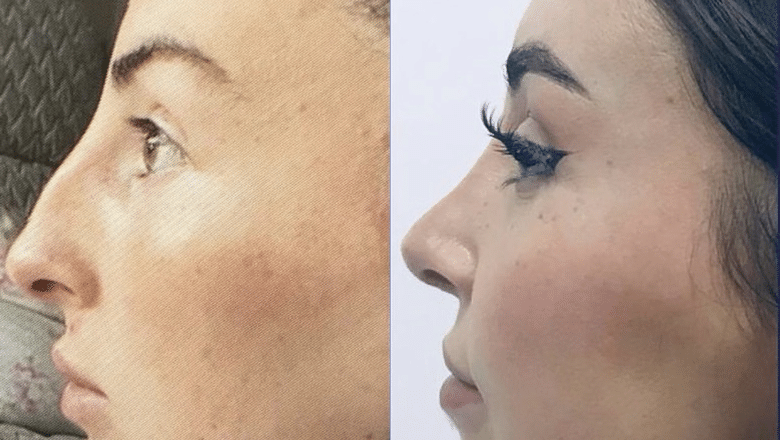
Can I Get a Celebrity’s Nose?
No, and a good surgeon will not promise you one. A nose is shaped by its skin, bone and cartilage, and it only looks right in proportion to the face around it. The same nose placed on a different face can look too small, too sharp or simply out of place.
Several things limit what can be copied:
- Skin thickness. Thick skin softens fine detail, so a very defined tip may not be achievable. Our guide on rhinoplasty for thick skin explains why.
- Your starting structure. Strong or weak cartilage, short nasal bones and the shape of the septum all set limits.
- Your other features. Your forehead, lips and chin change how a nose looks in profile. Sometimes a side profile concern is really about the chin.
- Your ethnic identity. A nose that keeps your heritage usually looks more natural than one borrowed from a different face. Our ethnic rhinoplasty page explains this approach.
Reference photos are still useful. They help you show what you like, such as a straighter profile, a softer tip or slimmer nostrils, more clearly than words can. The most helpful approach is to bring a few photos of noses you like and a few you don’t, and to talk about the features rather than the person.
Some surgeons also use computer simulations. One AI simulation tool tested in a 2024 study ↗ produced images that viewers could not reliably tell apart from real post-operative photographs, picking the simulation correctly only 52.5% of the time.[4] A simulation is a way to agree on direction, not a promise of the final shape. Our guide are my rhinoplasty expectations realistic? will help you think this through.
Male Celebrity Nose Jobs: How Rhinoplasty Differs for Men
Male celebrity nose jobs tend to be even harder to spot, because a natural male nose keeps a straight, strong bridge and a tip that is not turned up. The goal is a nose that looks balanced and masculine, not smaller at any cost.
A widely cited review of male rhinoplasty stresses that masculine features must be preserved, and that taking too much off the bridge or over-refining the tip produces unsatisfactory results in men.[5] Many men also have thicker skin on the nose, which limits how finely the tip can be refined. Our article on the differences between female and male rhinoplasty covers the angles and proportions surgeons plan for.

How Celebrity Culture and Social Media Shape Nose Job Requests
Admiring someone’s appearance is normal, but research suggests that strong attachment to a celebrity is linked with going on to have cosmetic surgery. In a UK study of 137 young adults, those with an intense personal attachment to a celebrity whose body they admired were more likely to have cosmetic surgery over the following eight months, even after other known factors were taken into account.[6]
Filters have added a new layer. Dermatologists at Boston University have written about patients bringing filtered selfies, rather than celebrity photos, as the look they want, a trend that has been nicknamed “Snapchat dysmorphia”.[7] Filtered faces often show a nose that no operation could produce. Our article on nose job trends on TikTok looks at how social media shapes expectations.
This matters because the noses that bother people most are not always the ones that look most different to others. In a 2011 study of 226 people seeking rhinoplasty in Plastic and Reconstructive Surgery ↗, 33% had at least moderate symptoms of body dysmorphic disorder, and how people rated their own nose was unrelated to how independent observers rated it.[8] The same research group later found that patients with more of these symptoms before surgery were less satisfied with their nose afterwards, at three months and at a year.[9] That is why a careful consultation asks about how your nose affects your life, not just what you would like to change. Our guide to body dysmorphia and cosmetic surgery explains what to expect.
How Popular Are Nose Jobs in the UK?
Rhinoplasty remains one of the more common cosmetic operations in the UK. The British Association of Aesthetic Plastic Surgeons’ 2025 audit recorded 1,595 rhinoplasties by its members: 1,322 in women, where it was the seventh most common operation, and 273 in men, where it was the second most common. The total was 18% lower than in 2024.[10] These figures cover BAAPS members only, so the real number of nose jobs in the UK is higher.
Some people also travel abroad for cheaper surgery. Our article on a nose job in Turkey covers what to weigh up before you do.
Is a Nose Job Worth It? Satisfaction, Regret and Revision Rates
Many people are pleased with the result, but not everyone is. In a 2013 review of 369 consecutive cosmetic rhinoplasties in Aesthetic Surgery Journal ↗, surgeons judged the nasal shape to be successfully corrected in 87% of patients. The overall complication rate was 7.9%, 15.4% of patients were dissatisfied to some degree, and 9.8% had a revision. Previous nasal surgery or a facial fracture and complications after surgery were linked to both dissatisfaction and revision, and leaving the tip untreated was linked to dissatisfaction.[11]
Breathing deserves as much attention as shape. In a study of 100 people having revision rhinoplasty, 65% said a blocked nose was one of their main complaints.[12] A nose that looks good but no longer works properly is not a good result, which is why your surgeon will check your airway as well as your profile. If a result does go wrong, our guides to a nose job gone wrong and revision rhinoplasty explain the options.
Recovery takes patience. The splint usually comes off after about a week and bruising fades over the following days. Most swelling settles within a few months, but the tip can take up to a year to refine, so the final result is not fully visible until then. Our rhinoplasty recovery guide has the week-by-week timeline.
What Happens at a Rhinoplasty Consultation?
At Centre for Surgery your consultation is with the surgeon who would perform your operation. They will:
- ask what bothers you about your nose and how long it has bothered you
- look at your nose from the front, side and below, and check your breathing
- assess your skin thickness, cartilage and the balance of your other features
- go through any reference photos with you, feature by feature
- explain which technique would suit you, what is realistic and what the risks are
We do not perform cosmetic rhinoplasty before 18, because the nose and face are still changing. Our article on the minimum age for rhinoplasty in the UK explains why. Surgery is usually a day case under total intravenous anaesthesia (TIVA), and you will need a responsible adult to take you home and stay with you for 24 hours. If you are not ready for surgery, a non-surgical rhinoplasty with filler can smooth a small bump or lift a tip for several months, though it cannot make a nose smaller. Current prices are in our rhinoplasty cost guide.
Frequently Asked Questions
Do celebrities have non-surgical nose jobs?
Some do, because filler can disguise a small bump or lift a drooping tip without time off. A review of eight studies found high satisfaction, with effects lasting around 8 to 14 months.[13] It adds volume, so it cannot narrow or shorten a nose, and it carries rare but serious risks if filler blocks a blood vessel. Our guide to non-surgical rhinoplasty explains who it suits.
What is the regret rate for nose jobs?
There is no single figure, because studies measure it differently. In one series of 369 cosmetic rhinoplasties, 15.4% of patients were dissatisfied to some degree and 9.8% had a revision.[11] Dissatisfaction was more likely after previous nasal surgery or injury and after complications, and in another study when symptoms of body dysmorphic disorder were present before surgery.[9]
How risky is a nose job?
Rhinoplasty is a well-established operation, but like all surgery it carries risks. Possible problems include bleeding, infection, a blocked nose, asymmetry, numbness of the tip and an appearance you are not happy with. In one series of 369 patients the overall complication rate was 7.9%.[11] Your surgeon will go through the risks that apply to you at consultation.
Is 30 too late for a nose job?
No. There is no fixed upper age limit for rhinoplasty, and many people have it in their thirties, forties or later. As the face ages, the skin thins and the tip can drop, which surgeons take into account when planning.[14] What matters more than age is your general health and what you want to achieve.
Can a nose job make you look younger?
Sometimes. With age, the nasal tip tends to droop and the nose can look longer. Lifting and supporting a drooping tip can soften this.[14]
What happens 20 years after rhinoplasty?
A good rhinoplasty result is long-lasting, but your nose keeps ageing like the rest of your face. The skin thins and the tip may drop slightly over the decades. Our article does your nose keep growing? explains what changes with age and why.
Can I bring a photo of a celebrity to my consultation?
Yes. A photo helps your surgeon understand the style you like. Expect them to talk about the features in it, such as the line of the bridge or the shape of the tip, and to explain which of those would suit your face and which would not.
Do celebrities use special techniques that aren’t available to everyone?
No. Celebrities have the same operations as anyone else: open or closed rhinoplasty, tip surgery, nostril reduction and, increasingly, preservation techniques. What makes a result look natural is careful planning and surgical experience, not a secret method.
Why Choose Centre for Surgery for Rhinoplasty?
Every rhinoplasty at Centre for Surgery is performed by a GMC-registered surgeon, at our CQC-regulated hospital at 95–97 Baker Street, which has been caring for patients for over 10 years. The surgeon who assesses you at consultation is the surgeon who performs your surgery. We offer primary, tip, ethnic, male, ultrasonic and revision rhinoplasty, along with septorhinoplasty for noses that need to breathe better as well as look different, so your surgeon can recommend the operation your nose needs. They will also tell you plainly if a change you have in mind will not suit you. We recommend a two-week cooling-off period before any surgery. We publish our clinical outcomes and patient safety data.
Finance is available through Chrysalis Finance, subject to status. See our finance options page for details.
Phone: 020 7993 4849 | Address: 95–97 Baker Street, Marylebone, London W1U 6RN
Contact us to schedule a consultation
References
- General Medical Council. Cosmetic interventions: key points. gmc-uk.org ↗
- Ward B, Ward M, Fried O, Paskhover B. Nasal distortion in short-distance photographs: the selfie effect. JAMA Facial Plastic Surgery 2018;20(4):333–335. doi:10.1001/jamafacial.2018.0009 ↗
- Kim DH, Jang DW, Hwang SH. Comparison of patient-reported outcomes between dorsal preservation and conventional dorsal hump reduction rhinoplasty: a systematic review and meta-analysis. Aesthetic Plastic Surgery 2025;49(17):4846–4856. doi:10.1007/s00266-025-04828-6 ↗
- Knoedler S, Alfertshofer M, Simon S, et al. Turn your vision into reality: AI-powered pre-operative outcome simulation in rhinoplasty surgery. Aesthetic Plastic Surgery 2024;48(23):4833–4838. doi:10.1007/s00266-024-04043-9 ↗
- Rohrich RJ, Janis JE, Kenkel JM. Male rhinoplasty. Plastic and Reconstructive Surgery 2003;112(4):1071–1085. doi:10.1097/01.PRS.0000076201.75278.BB ↗
- Maltby J, Day L. Celebrity worship and incidence of elective cosmetic surgery: evidence of a link among young adults. Journal of Adolescent Health 2011;49(5):483–489. doi:10.1016/j.jadohealth.2010.12.014 ↗
- Rajanala S, Maymone MBC, Vashi NA. Selfies: living in the era of filtered photographs. JAMA Facial Plastic Surgery 2018;20(6):443–444. doi:10.1001/jamafacial.2018.0486 ↗
- Picavet VA, Prokopakis EP, Gabriëls L, Jorissen M, Hellings PW. High prevalence of body dysmorphic disorder symptoms in patients seeking rhinoplasty. Plastic and Reconstructive Surgery 2011;128(2):509–517. doi:10.1097/PRS.0b013e31821b631f ↗
- Picavet VA, Gabriëls L, Grietens J, Jorissen M, Prokopakis EP, Hellings PW. Preoperative symptoms of body dysmorphic disorder determine postoperative satisfaction and quality of life in aesthetic rhinoplasty. Plastic and Reconstructive Surgery 2013;131(4):861–868. doi:10.1097/PRS.0b013e3182818f02 ↗
- British Association of Aesthetic Plastic Surgeons. 2025 audit results. Published 2026. baaps.org.uk ↗
- Neaman KC, Boettcher AK, Do VH, et al. Cosmetic rhinoplasty: revision rates revisited. Aesthetic Surgery Journal 2013;33(1):31–37. doi:10.1177/1090820X12469221 ↗
- Lee M, Zwiebel S, Guyuron B. Frequency of the preoperative flaws and commonly required maneuvers to correct them: a guide to reducing the revision rhinoplasty rate. Plastic and Reconstructive Surgery 2013;132(4):769–776. doi:10.1097/PRS.0b013e3182a01457 ↗
- Radulesco T, De Bonnecaze G, Penicaud M, Dessi P, Michel J. Patient satisfaction after non-surgical rhinoplasty using hyaluronic acid: a literature review. Aesthetic Plastic Surgery 2021;45(6):2896–2901. doi:10.1007/s00266-021-02182-x ↗
- Rohrich RJ, Hollier LH, Janis JE, Kim J. Rhinoplasty with advancing age. Plastic and Reconstructive Surgery 2004;114(7):1936–1944. doi:10.1097/01.prs.0000143308.48146.0a ↗







