

In this guide12 sections
- Key Points
- What Actually Counts as an Alternative to Breast Implants?
- Fat Transfer to Breast: The Genuine Surgical Alternative
- Hybrid Breast Augmentation: Implant Plus Fat Transfer
- Breast Implant Risks Compared With Fat Transfer
- Can You Get Bigger Breasts Without Surgery?
- Recovery After Fat Transfer vs Implants
- Breast Asymmetry and Tuberous Breasts: When It Isn’t Only About Size
- Which Alternative Is Right for You?
- Frequently Asked Questions
- Talk to Us About Alternatives to Breast Implants
- References
Key Points
- Fat transfer is the only proven surgical alternative to breast implants. It uses your own fat, so there is no implant to rupture or develop capsular contracture.
- It adds a modest amount of volume, usually up to around one and a half cup sizes per session, and a little over half of the injected fat survives long term.
- Hybrid augmentation combines a smaller implant with fat transfer for more volume with softer edges.
- No cream, supplement, pump or exercise has been shown to increase breast size.
- Implants still give the largest, most predictable increase. The right choice depends on how much volume you want and how much donor fat you have.
If you’re searching for alternatives to breast implants, it’s worth starting with an honest distinction that most articles on this topic blur: there is exactly one genuine surgical alternative to implants — fat transfer to the breast — and there is a much larger, much noisier category of non-surgical products and techniques with no reliable evidence behind them. This guide covers both, clearly separated, along with hybrid augmentation (which combines the two), the real safety profile of implants themselves, recovery timelines, and how to decide which route is right for you.
Breast augmentation remains the most popular cosmetic surgery procedure in the UK, and interest in implant-free routes has grown alongside it — driven partly by concerns about long-term implant surveillance, and partly by a simple preference for using the body’s own tissue. Our guides to breast implant safety and breast implant illness cover those concerns in detail. At Centre for Surgery, our surgeons offer the full range of options, from breast augmentation with implants to fat transfer and hybrid techniques, so you can make an informed choice rather than being steered toward a single default.
What Actually Counts as an Alternative to Breast Implants?
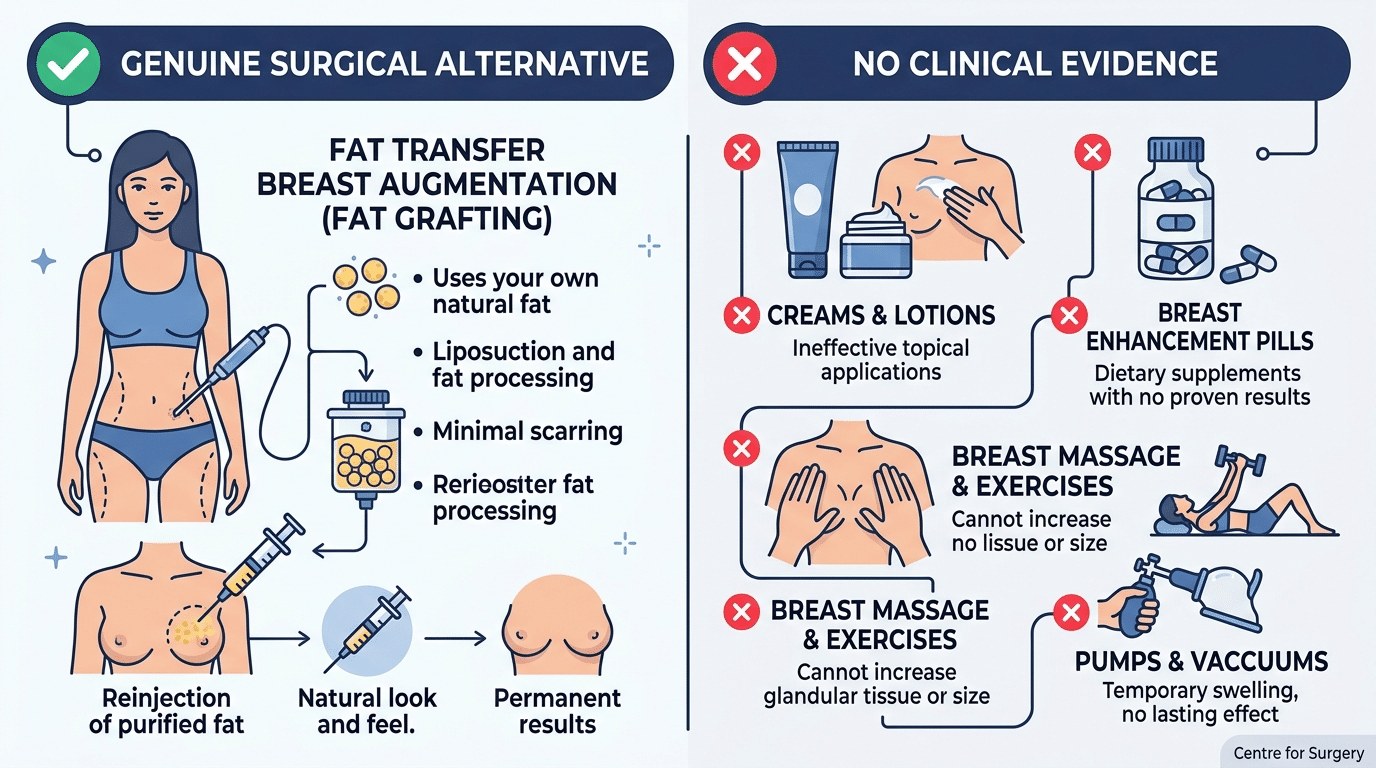
Searching this topic online turns up a wide mix of results — some genuinely medical, others closer to marketing. It’s worth being clear from the outset: no cream, supplement, massage technique, exercise routine, or suction device has been shown to increase breast size or replace what an implant does. These are covered in detail in our companion guides on whether breast enlargement creams and supplements really work and how to increase breast size, so we won’t repeat the full breakdown here — the short version is that none of them are a genuine alternative to surgery, non-surgical or otherwise.
The one method that qualifies as a surgical alternative — using your own tissue rather than an implanted device — is fat transfer to the breast, sometimes called natural breast augmentation. A breast lift (mastopexy) can also improve apparent fullness for some patients without adding any volume at all, though it isn’t a true substitute for augmentation if genuine size increase is the goal. It’s also worth noting that “alternative” doesn’t have to mean “instead of implants forever” — some patients start with fat transfer and later add implants if their goals change, while others move the opposite direction, from implants to implant removal with fat grafting. Your options aren’t locked in permanently by an early choice.
Fat Transfer to Breast: The Genuine Surgical Alternative
Fat transfer breast augmentation uses your own fat — harvested from another area of the body via liposuction, purified, and reinjected into the breast — to add volume and improve shape without introducing any implant material. No foreign device is involved, so it avoids the specific implant-related risks covered later in this guide entirely: no capsular contracture, no risk of implant rupture, and no need for the periodic implant surveillance imaging that implant patients are advised to undergo.
The trade-off is scale. Fat transfer alone typically achieves an increase of around half a cup to one and a half cup sizes per session — in practical terms, this usually means around 300 to 400cc of processed fat injected per breast for a noticeable, proportionate change, though the exact volume depends on your donor supply and how much of the graft is expected to survive. Not all of the transferred fat survives the transfer process — some is naturally reabsorbed by the body in the months following surgery, which is why final results aren’t fully evident until around the six-month mark. A 2024 systematic review of 35 studies and 3,757 women found an average of 58% of the injected volume was retained, and patient satisfaction averaged 92% after a year. The same review reported an overall complication rate of 27.8%, most often fat necrosis, which can cause firm lumps (Seth et al., 2024 ↗).[1] An earlier review found small calcifications on mammograms in around one in ten women after fat transfer, so tell the radiographer about your surgery if you have breast screening.[2] For patients who want a larger, more dramatic size increase in a single procedure, implants remain more effective. For patients who want a modest, natural-feeling increase, fat transfer is often the preferred route. Our full comparison, Breast Implants vs Fat Transfer: Which Is Best For You?, covers the trade-offs in detail.
Suitability for fat transfer depends heavily on having sufficient donor fat available — common donor sites include the abdomen, flanks, thighs, and lower back, meaning the procedure works best for patients with some excess fat to spare in at least one of these areas. Very lean patients with minimal donor fat may not be good candidates for a meaningful volume increase this way, and your surgeon will assess this honestly at consultation rather than promising a result the donor sites can’t support. The procedure itself is typically completed in a single day-case session, combining the liposuction harvest and the breast injection stage — a genuine bonus for patients who also want some body contouring at the donor site, since that excess fat is removed as part of the same surgery.
Fat transfer also has a useful secondary role even for patients who do choose implants: it can be layered around implant edges to soften visibility and rippling in slimmer patients — which brings us to hybrid augmentation.
Hybrid Breast Augmentation: Implant Plus Fat Transfer
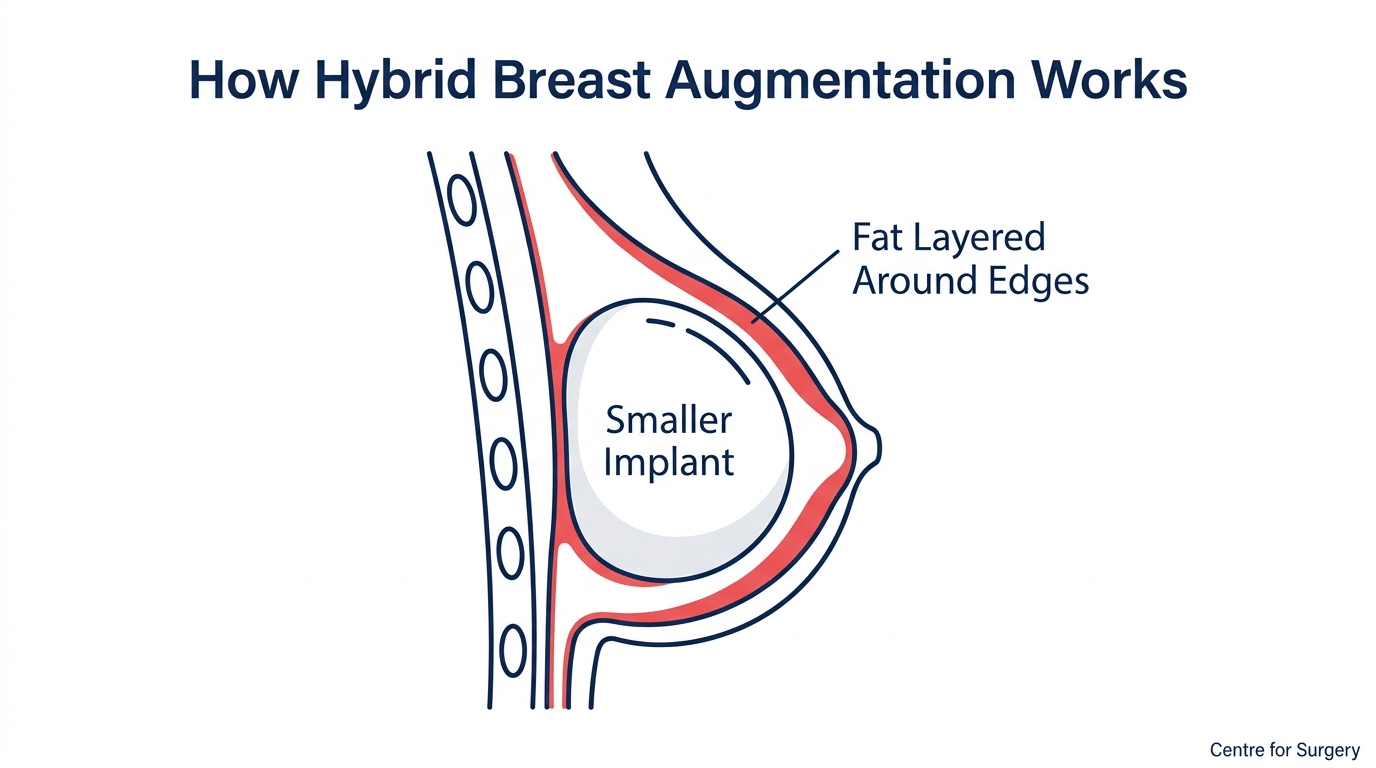
Hybrid (composite) breast augmentation combines a smaller implant with fat transfer layered around its edges. This isn’t a compromise so much as a distinct option: it delivers the predictable, controllable size increase that implants provide, while the fat layer softens the implant’s edges and adds a natural feel and contour that implants alone can’t fully replicate — particularly valuable for slimmer patients with limited natural breast tissue to disguise the implant. Our guide to the ballerina boob job shows how this works for a small, natural result.
A smaller implant is used than in a standard augmentation, so some of the implant-specific risks are also somewhat reduced, though not eliminated, since an implant is still present. This makes hybrid augmentation a genuine middle path between “implant only” and “fat transfer only” for patients who want more volume than fat transfer alone can provide, without the fuller commitment of a large standalone implant. It also suits patients who’ve previously had implants and are looking to downsize while adding a softer, more natural contour at the same time — a combination that’s difficult to achieve with either approach alone.
Breast Implant Risks Compared With Fat Transfer
Understanding implant risk properly is part of making an informed choice between implants and their alternatives — not to alarm, but because vague or incomplete risk information (or none at all) makes it hard to weigh the decision fairly.
Capsular Contracture
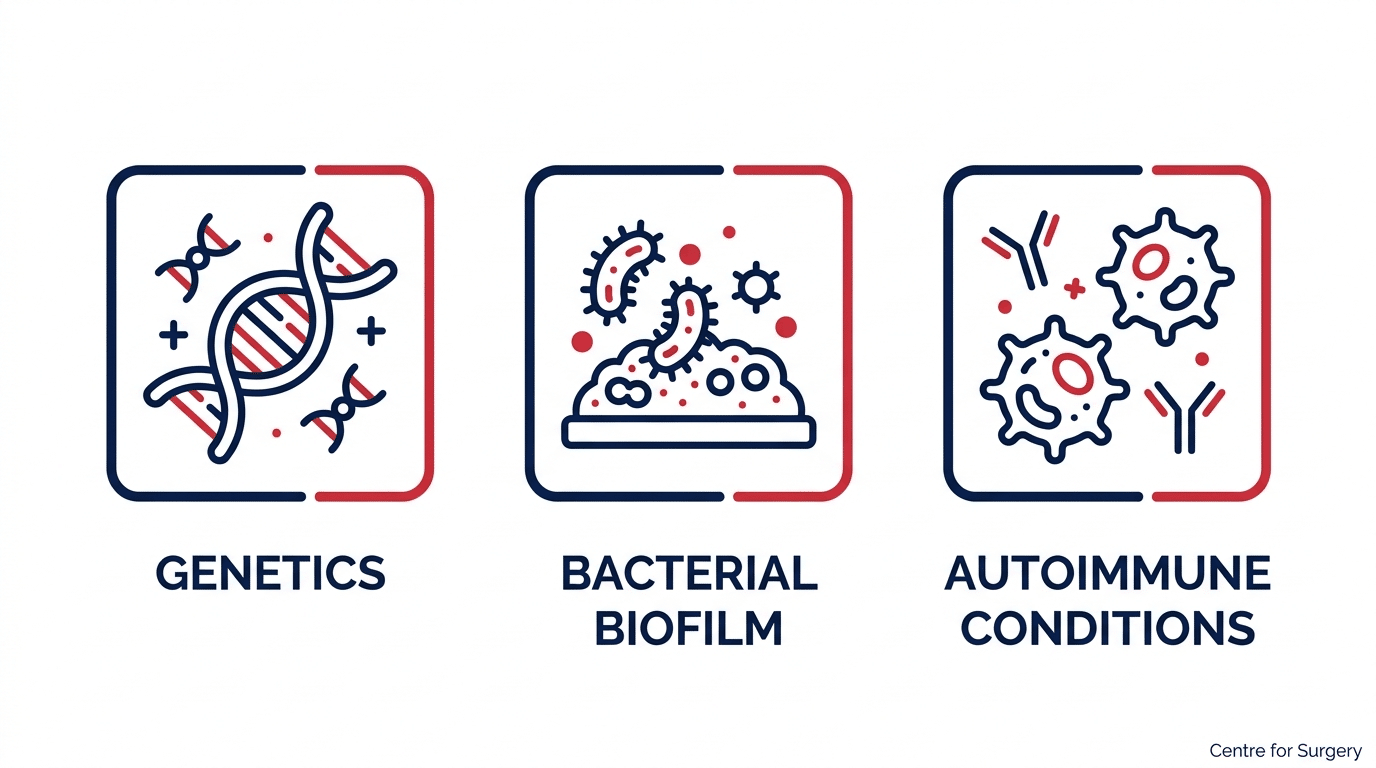
Following implant insertion, scar tissue naturally forms around the implant as part of normal healing. In some cases, over time, this scar tissue can harden and contract, squeezing the implant and causing firmness, distortion, or pain — this is known as capsular contracture. It’s the most common long-term implant complication: a 10-year study of 2,565 women having a first augmentation found a rate of 10.8% per implant.[3] A systematic review found the strongest evidence for these risk factors:[4]
- Bacterial biofilm — the leading theory is that a thin, often undetected layer of bacteria on the implant surface triggers a low-grade, persistent inflammatory response that thickens the scar tissue
- Haematoma — a collection of blood around the implant after surgery
- Placement over the muscle rather than under it
- Radiotherapy and reconstruction after breast cancer, and the length of time the implant has been in
Our full guide to capsular contracture covers the grades and treatment.
Meticulous surgical technique — correct implant size and type selection, careful pocket creation, and a sterile “no-touch” insertion technique — significantly reduces this risk, which is why implant surgery should only ever be performed by a suitably experienced consultant plastic surgeon. If contracture does develop, it can range from mild firmness that doesn’t require treatment through to more significant distortion that requires revision surgery to correct — your surgeon will discuss the grading system and treatment options with you if this becomes relevant.
Rupture and Rippling
Modern silicone implants are designed to hold their shape even if the outer shell is compromised, but rupture can still occur over the lifespan of an implant. Rupture rates start very low and begin to rise after about 6 to 8 years,[6] so implants aren’t lifetime devices, and periodic checks are sensible even without symptoms, since silicone rupture is not always noticeable (“silent rupture”). Our guide to breast implant rupture explains the signs. Rippling — visible or palpable folds in the implant surface — is more common than many patients expect, and slim women with less natural breast tissue are most affected.[5] It can be reduced with correct implant selection and placement, or addressed with fat grafting around the edges as described above.
Infection
Surgical site infection is a recognised, though uncommon, risk of any implant procedure, since the presence of a foreign device provides a surface bacteria can adhere to. Meticulous sterile technique during surgery substantially reduces this risk. Signs of infection typically include increasing redness, warmth, swelling, or pain around the breast, sometimes with fever — any of these should be reported to your surgical team promptly, since early treatment is far more straightforward than delayed treatment.
Can You Get Bigger Breasts Without Surgery?
It’s worth briefly restating the honest picture, since so much marketing pushes the opposite message: no cream, oral supplement, massage technique, or suction pump has been shown in properly conducted clinical research to increase breast size or serve as a real alternative to surgical augmentation. Some of these products rely on phytoestrogens — plant compounds that bind only weakly to oestrogen receptors, nowhere near potently enough to replicate what actual oestrogen does to breast tissue during puberty or pregnancy. Others, like suction devices, cause only temporary fluid-related swelling that resolves within hours, and push-up or padded bras can improve appearance in clothing without changing the breast itself. For the complete picture with the full evidence breakdown, see our dedicated guide: Do Breast Enlargement Creams and Supplements Really Work?
Recovery After Fat Transfer vs Implants
Recovery timelines differ meaningfully between the three surgical routes, and it’s worth factoring this in alongside the aesthetic considerations above. Standard implant surgery typically involves one to two weeks off work, with swelling and bruising settling over the first two weeks and final results evident by around six weeks. Fat transfer recovery involves two surgical sites — the donor area and the breast — so initial downtime can feel more involved in the first week, though overall recovery time is broadly similar; final results, however, take considerably longer to settle, since the transferred fat continues to establish blood supply for up to six months. Hybrid augmentation recovery generally falls between the two, reflecting its combined nature. All three are performed as day-case procedures at Centre for Surgery, meaning you go home the same day regardless of which option you choose.
Breast Asymmetry and Tuberous Breasts: When It Isn’t Only About Size
Not everyone looking at implant alternatives simply wants bigger breasts. Some people have breasts of noticeably different sizes (breast asymmetry), or a tuberous breast shape, where the base of the breast is narrow, the lower half is underdeveloped and the areola may bulge. These are developmental differences rather than illness, but they can make bras and swimwear hard to fit, mean padding one side every day, and make exercise or intimacy feel awkward.
Fat transfer suits this kind of correction because small, precise volumes can be placed exactly where tissue is missing. In a 2026 BREAST-Q study of tuberous breast correction ↗, women treated with fat grafting alone reported higher physical well-being and satisfaction with outcome than those given implants, with fewer complications.[7] A 2017 long-term follow-up ↗ found that 62% of implant-corrected tuberous breasts needed further surgery, against 29% of those corrected with the patient’s own tissue.[8] Fat transfer often takes more than one session, and larger differences may still be best treated with an implant on one or both sides, or a tuberous breast correction that combines techniques. Reconstruction after breast cancer surgery is a separate field, planned with your breast cancer team.
Which Alternative Is Right for You?
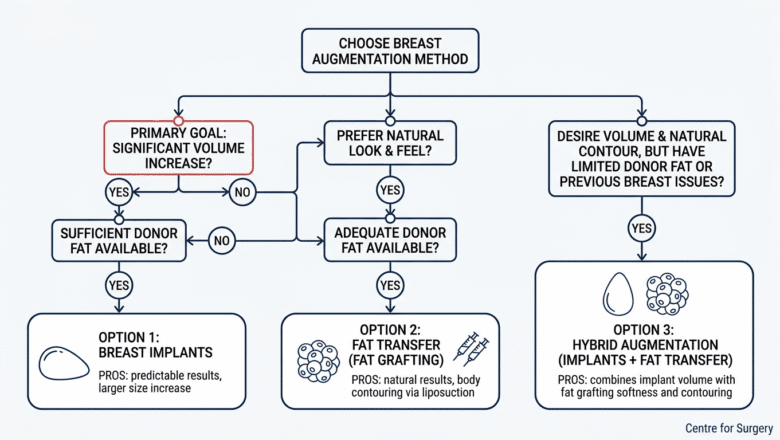
- Choose fat transfer if: you want a modest, natural-feeling increase, want to avoid implant-specific risks entirely, and have sufficient donor fat available.
- Choose hybrid augmentation if: you want more volume than fat transfer alone can provide, but also want softer, more natural contouring than a standalone implant typically gives — especially if you’re slim with limited natural breast tissue.
- Choose standard implants if: you want the most significant, predictable size increase achievable in a single procedure, and are comfortable with the implant-specific considerations covered above.
A face-to-face consultation with one of our surgeons is the only reliable way to know which option fits your anatomy, donor fat availability, and goals — not a generic online comparison. Bring photos of results you like and be candid about what matters most to you, whether that’s maximum size, minimum risk, or the most natural possible feel; a good consultation works backward from your priorities rather than forward from a single recommended procedure.
Frequently Asked Questions
Is there a real alternative to breast implants?
Yes — fat transfer to the breast is the one method that qualifies as a surgical alternative, using your own tissue rather than an implanted device. Hybrid augmentation combines this with a smaller implant. No non-surgical product or technique has been shown to be a genuine alternative.
Can you get breast augmentation without surgery?
Not in any way that produces a genuine, lasting increase in breast size. Non-surgical products and techniques (creams, supplements, massage, pumps) have no reliable clinical evidence behind them. If breast augmentation without surgery is your goal because you specifically want to avoid an implanted device, fat transfer — which is still a surgical procedure, just implant-free — is the closest genuine option.
What is the natural alternative to a boob job?
Fat transfer breast augmentation, sometimes called a “natural boob job,” is the established surgical alternative that uses your own body fat rather than a synthetic implant.
How common is capsular contracture?
A 10-year study of women having a first breast augmentation found a rate of around one in ten implants,[3] so most women never develop it. Rates vary with implant placement, surgical technique and individual factors, and our capsular contracture guide explains what affects your risk.
Is fat transfer safer than implants?
Fat transfer avoids implant-specific risks like capsular contracture and implant rupture entirely, since no device is inserted. It carries its own separate set of risks related to the liposuction and fat-grafting process, which your surgeon will discuss with you. Neither option is risk-free, but the risk profiles are different.
Can fat transfer fully replace implants?
For patients wanting a dramatic size increase, no — fat transfer alone typically achieves up to one and a half cup sizes per session, considerably less than implants can provide. For patients wanting a modest, natural increase, it can be a complete alternative on its own.
Can I combine fat transfer with a breast lift?
Yes — for patients dealing with both a loss of volume and some degree of sagging, fat transfer is often combined with a breast lift in the same procedure, addressing shape and position alongside the added volume.
Does fat transfer leave visible scarring?
Scarring from fat transfer is typically minimal, since fat is injected through small needle entry points rather than the larger incisions implant surgery requires, plus the small incisions needed for the liposuction donor site itself, which are usually placed in inconspicuous locations.
Is there a safer alternative to breast implants?
Fat transfer avoids the risks that come from an implant itself, such as capsular contracture, rupture and future replacement, and in tuberous breast studies it has had fewer complications. It is not risk-free: some of the transferred fat is reabsorbed, and fat necrosis or oil cysts can form firm lumps that may need imaging. For a modest increase it carries fewer long-term implications; for a large increase, an implant remains the more reliable option.
Can you lift saggy breasts without implants?
Yes. A breast lift (mastopexy) removes excess skin and reshapes and raises your own breast tissue and nipple without adding volume. It suits breasts that have dropped after pregnancy, breastfeeding or weight loss but still have reasonable volume. Fat transfer can add upper fullness at the same time, and an implant is only needed if you also want to go up a size. Creams and exercise cannot lift breast tissue.
What is the new boob job method called?
There is no single new method. People usually mean fat transfer breast augmentation (often called a natural boob job), hybrid or composite augmentation, which combines a smaller implant with fat for a softer edge, or refinements in implant surgery such as no-touch insertion with a Keller funnel. All three are available at Centre for Surgery, and your surgeon will explain which suits your anatomy.
Talk to Us About Alternatives to Breast Implants
At Centre for Surgery, breast augmentation — whether with implants, fat transfer, or a hybrid approach — is performed by GMC-registered plastic surgeons, at our CQC-regulated Baker Street facility, rated Good overall. We use Silimed implants as standard, with Mentor and Motiva also available on request. Where appropriate, procedures are performed under TIVA (Total Intravenous Anaesthesia) as a day case, with a recommended two-week cooling-off period as standard.
Your surgeon will give you an honest, individual assessment at consultation of which option — implants, fat transfer, or hybrid — suits your anatomy and goals, so you can decide with confidence rather than a fixed assumption made before you’ve even walked through the door.
Finance options are available through our partner Chrysalis Finance, subject to status. Visit our Finance Options page for details.
To book a consultation, call 020 7993 4849 or email contact@centreforsurgery.com. We’re located at 95-97 Baker Street, London W1U 6RN.
References
- Seth I, Bulloch G, Gibson D, et al. Autologous fat grafting in breast augmentation: a systematic review highlighting the need for clinical caution. Plast Reconstr Surg. 2024;153(3):527e-538e. doi:10.1097/PRS.0000000000010614 ↗
- Groen JW, Negenborn VL, Twisk JWR, et al. Autologous fat grafting in cosmetic breast augmentation: a systematic review on radiological safety, complications, volume retention, and patient/surgeon satisfaction. Aesthet Surg J. 2016;36(9):993-1007. doi:10.1093/asj/sjw105 ↗
- Calobrace MB, Stevens WG, Capizzi PJ, et al. Risk factor analysis for capsular contracture: a 10-year Sientra study using round, smooth, and textured implants for breast augmentation. Plast Reconstr Surg. 2018;141(4S):20S-28S. doi:10.1097/PRS.0000000000004351 ↗
- Bachour Y, Bargon CA, de Blok CJM, et al. Risk factors for developing capsular contracture in women after breast implant surgery: a systematic review of the literature. J Plast Reconstr Aesthet Surg. 2018;71(9):e29-e48. doi:10.1016/j.bjps.2018.05.022 ↗
- Swanson E. Prospective study of saline versus silicone gel implants for subpectoral breast augmentation. Plast Reconstr Surg Glob Open. 2020;8(6):e2882. doi:10.1097/GOX.0000000000002882 ↗
- Hillard C, Fowler JD, Barta R, Cunningham B. Silicone breast implant rupture: a review. Gland Surg. 2017;6(2):163-168. doi:10.21037/gs.2016.09.12 ↗
- Dibiase L, Ruiz F, Haye B, et al. Comparative study of patient-reported outcomes following autologous fat grafting versus implant-based augmentation in tuberous breast deformity. Aesthetic Plast Surg. 2026;50(13):5081-5090. doi:10.1007/s00266-026-05902-3 ↗
- Tenna S, Cagli B, Brunetti B, Barone M, Persichetti P. Management of tuberous breast deformities: review of long-term outcomes and patient satisfaction with BREAST-Q. Aesthetic Plast Surg. 2017;41(6):1249-1258. doi:10.1007/s00266-017-0902-3 ↗