


In this guide7 sections
- Why Are My Boobs Pointy?
- Is It Normal to Have Pointy Boobs?
- Conical Breasts vs Tuberous Breast Deformity: What’s the Difference?
- What If I Am Unhappy With the Shape of My Breasts?
- Is It Normal for Boobs to Look Pointy After Breast Augmentation?
- Frequently Asked Questions
- Breast Shape Surgery at Centre for Surgery
Why Are My Boobs Pointy?
The development of breasts is an incredibly unique and personal experience, varying from one individual to another. Pointy — or conical — breasts are simply one point on the normal spectrum of breast shape, not a fault or a flaw. It is entirely natural to feel dissatisfied with the size, shape, or positioning of your breasts, but it’s worth being clear from the outset: having a naturally more pointed breast shape is common and normal, and isn’t the same thing as having a diagnosable breast condition. Once breast tissue growth is complete, some women choose to explore cosmetic breast surgery at Centre for Surgery in London to address concerns about shape — but this is a choice, not a medical necessity.
Is It Normal to Have Pointy Boobs?
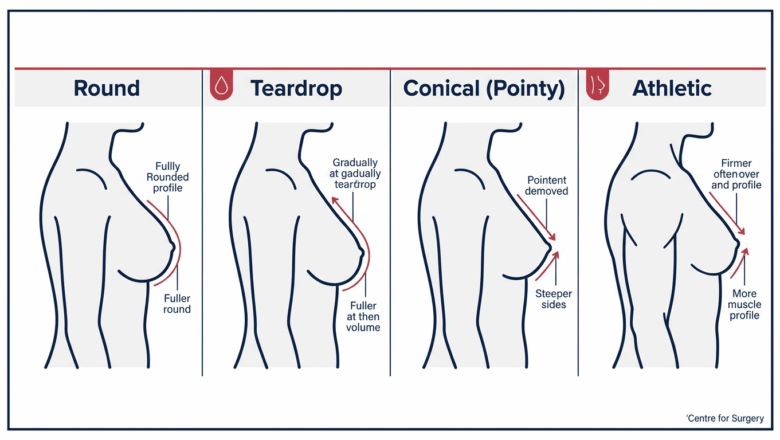
Yes — it is entirely normal to have pointy or conical breasts. Breast shape and size vary significantly between individuals, and conical breasts sit firmly within the normal range of human anatomy, alongside round, teardrop, and athletic shapes. Our guide to breast shapes shows the common types side by side, with charts. No two breasts are exactly alike, even on the same person.
Various factors — genetics, hormonal changes, and body composition — influence breast shape and size. Breast development typically begins during puberty, and the final shape may take several years to mature fully. Some women develop rounder, fuller breasts, while others naturally have a more conical or pointed shape. There is no single standard for what constitutes the “correct” breast appearance.
That said, societal expectations and personal preferences can influence how someone perceives their own breasts. For those who feel self-conscious about a naturally conical shape, cosmetic breast surgery procedures such as breast augmentation can be considered, entirely as a matter of personal choice.
Conical Breasts vs Tuberous Breast Deformity: What’s the Difference?
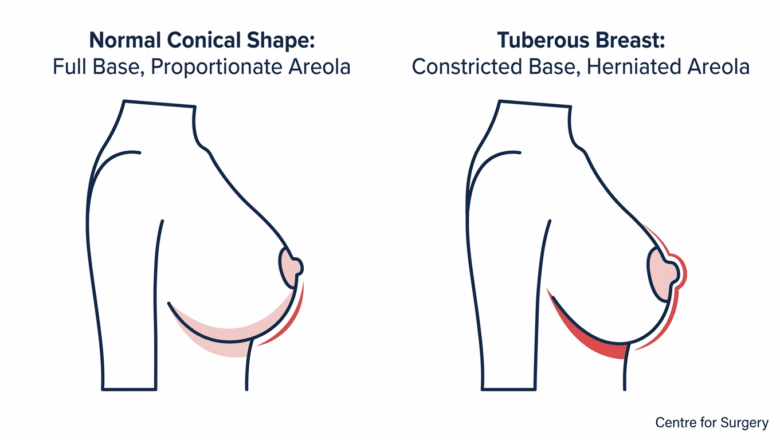
This is an important distinction, and one that’s often blurred online. A naturally pointy or conical breast shape is not the same thing as tuberous (tubular) breast deformity, a genuine congenital condition with specific diagnostic features:
- Conical breast shape (normal variant): a fuller, more pointed breast contour with a proportionate base width and normal areola size — simply one natural shape among many.
- Tuberous breast deformity: a constricted breast base, a herniated or “puffy” areola where breast tissue pushes through, minimal lower-pole breast tissue, and often a significant difference in the two breasts. This is a recognised congenital condition, not a shape variant.
If your breasts are simply pointed but otherwise proportionate — without a narrow, constricted base or a herniated areola — you very likely have a normal conical breast shape rather than tuberous breast deformity. If you’re unsure which applies to you, our dedicated guide to tubular breasts — causes and treatments covers the deformity in full detail, including corrective surgical technique. A consultation with a specialist surgeon can also confirm which category applies to you.
What If I Am Unhappy With the Shape of My Breasts?
If you’re dissatisfied with a naturally conical breast shape, there are options to change it, purely as a matter of personal preference. When you schedule a consultation at Centre for Surgery, our surgeons will provide personalised guidance on which technique best suits your goals.
Before making any decisions, it’s worth having an open conversation with your surgeon about your goals and concerns, so they can recommend the most suitable procedure for your specific anatomy.
Breast Augmentation

Breast implants add volume and can soften a conical contour into a rounder, fuller shape. They can also provide a subtle lift to address mild sagging. We use Silimed silicone implants as our exclusive standard. If a natural look matters most to you, see which breast implants look most natural.
Breast Lift
Where a conical shape is accompanied by sagging, breast lift (mastopexy) reshapes and elevates the breast tissue for a rounder, more lifted contour.
Breast Augmentation with an Uplift
A breast augmentation with a lift, also known as augmentation mastopexy, combines added volume with repositioning, addressing both shape and position together.
Fat Transfer
For a more subtle, natural rounding of a conical shape, fat transfer to the breast uses your own body fat to soften the contour without an implant.
Ultimately, the choice of procedure should be based on your personal preferences, medical history, and desired outcome. It’s important to have realistic expectations — cosmetic breast surgery can meaningfully change breast shape, but it may not achieve absolute uniformity.
Is It Normal for Boobs to Look Pointy After Breast Augmentation?
Yes — it’s common for breasts to appear pointy or slightly unnatural shortly after breast augmentation, and in most cases this is temporary. Reasons include:
Swelling
Postoperative swelling is expected after any surgical procedure, including breast augmentation. This can make the breasts appear more prominent or pointy than their eventual shape, and it resolves gradually over the following weeks.
Implant Position
Immediately after surgery, implants may sit higher on the chest due to the tightness of the chest muscles and surrounding tissue. As tissue relaxes, the implants settle into a more natural position — the “drop and fluff” phenomenon.
Implant Type and Size
Implant shape, size, and profile can influence the initial appearance. High-profile implants may create a more pointed look at first, which typically softens as tissue accommodates the implant over time.
Capsular Contracture
In rare cases, a pointy or misshapen appearance can result from capsular contracture, where scar tissue around the implant tightens. If this occurs, consult your surgeon for evaluation and treatment options.
Frequently Asked Questions
Are conical or pointy breasts a medical problem?
No. A naturally conical or pointy breast shape is a normal anatomical variant, not a medical condition. It doesn’t require treatment unless you personally want to change how it looks.
How do I know if I have conical breasts or tuberous breast deformity?
The key distinguishing features of tuberous breast deformity are a constricted, narrow breast base and a herniated or “puffy” areola where tissue pushes through — features a normal conical shape doesn’t have. A consultation with a specialist surgeon can confirm which applies to you.
Will my pointy breasts change shape naturally over time?
Breast shape can change with hormonal shifts, weight changes, pregnancy, and ageing, but a naturally conical shape typically remains a consistent underlying characteristic throughout life unless surgically altered.
Do I need surgery for pointy breasts?
No. Since conical breast shape is a normal variant rather than a medical issue, surgery is entirely optional and based on personal preference, not clinical necessity.
Breast Shape Surgery at Centre for Surgery
At Centre for Surgery, breast augmentation, lift, and fat transfer are performed by GMC-registered plastic surgeons, at our CQC-regulated Baker Street facility, rated Good overall, under TIVA (Total Intravenous Anaesthesia) as a day case. Our medical content is reviewed by Specialist Plastic Surgeon Dr Spyridon Vlachos (GMC 7522950).
See real patient outcomes in our before and after photo gallery, or read verified patient reviews on Google ↗ or on our own patient reviews page. For costs, see our boob job cost guide. Flexible finance options through Chrysalis Finance are available for procedures over £1,500.

Related Articles
- Scarless Breast Lift – Is a Mastopexy Without Scars Possible?
- Small or Large Areolas? How to Choose the Ideal Size for Your Breast Lift or Reduction
- Tubular Breasts – Causes and Treatments






